Showing posts with label agriculture. Show all posts

Monday, December 14, 2015

The Difference Between Dirt and Soil

Dirt and soil - they mean the same thing, right? Not to a scientist. My graduate school soils teacher had this to say about the topic: "Dirt is dead. Soils are not."

 Soils are actually pretty complex. According to Brady and Weil, in their fine volume The Nature and Properties of Soils:

The four major components of soil are air, water, mineral matter, and organic matter.

What does that mean exactly? Let's break it down.

Air in soil is contained in pore spaces. Different soils have varying amounts of pore space. A well-aerated soil is more likely to grow crops, since it is easier for plants to stretch out their roots. If a soil is highly compacted, nothing is going to grow there. Think of tight packed clay, for example.

Water in soil is pretty easy to visualize. A sandy desert soil, for example, might retain very little water, even after a rain. But a soil higher in organic content, like a loam, will hold more water.

Mineral matter simply refers to the type of bedrock from which the soil was derived. Bedrock is sometimes referred to as a soil's "parent material." A soil that came from granite will have different properties than a soil derived from limestone. (According to this article in Soil Science and Plant Nutrition, red limestone-based soils have higher levels of trace elements than soils derived from other types of bedrock.) 

Organic matter in soil consists of plant or animal residues along with soil-dwelling critters like earthworms. This is probably the biggest difference between dirt and soil, and is the origin of the comment above from my professor: soils are living ecosystems.  

Soils are probably the most underrated of all ecological resources. If you think about it, everything we do depends upon the soil. We rely upon soils to filter the water we drink. We need soils to grow crops for food, lumber for housing, cotton and hemp for clothing. How well a soil compacts - or doesn't - affects our ability to build homes and businesses. In short, we shouldn't treat soil like dirt! 
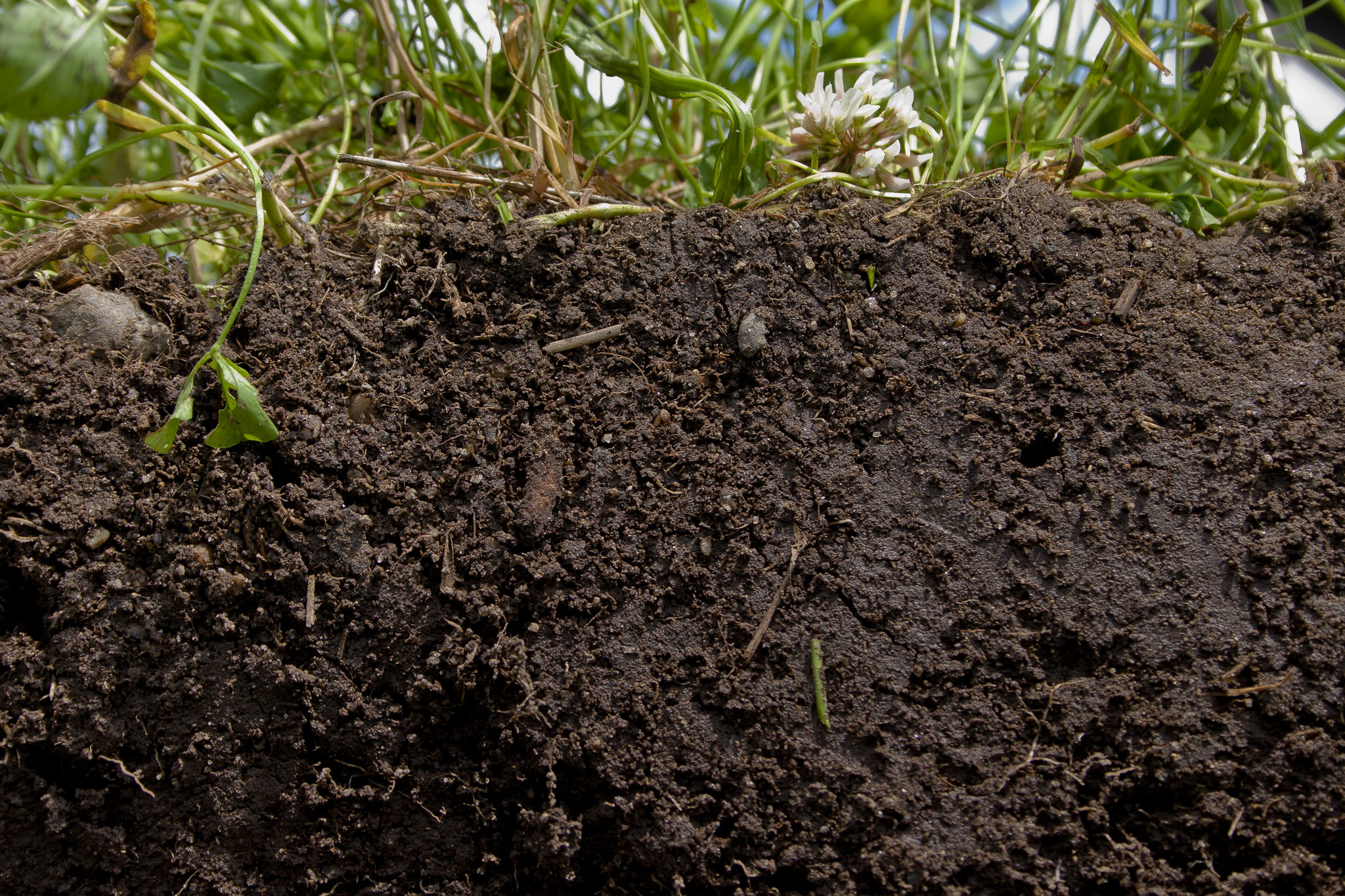
See what healthy soil looks like

This soil from Illinois is high in organic matter. Photo credit: Natural Resources Conservation Service Soil Health Campaign, via Flickr

Thursday, November 4, 2010

Adventures in Local Eating: The Pumpkin Edition

When my friend Lazy Locavore first talked with me about her food choices, I thought that I had misheard her.

"You're a loco-vore?" I asked. "A crazy-eater?"

"No," she said with a laugh. "I'm a locavore. I eat locally-grown foods."

I didn't think much about this until she handed me a pound of locally-raised ground beef.

"Try this," she said.

I put the meat in my refrigerator. Again, I didn't think much about it until I took the meat out and actually looked at it. This was Meat with a capital M. It smelled fresh, it looked fresh, and it was very moist, almost bloody. I could practically visualize the cow, which initially set me back a bit. But my husband and I persisted and soon we had tasty hamburgers for dinner.

"Huh," I thought. "Maybe there is something to this locally-grown food stuff."

A couple of weeks later, I was standing in a farmer's market, looking for ripe apples. Taking a sniff of the rich and lovely scent of fresh produce, I realized something. I miss the smell of food. So many things you pick up in the grocery store these days are almost devoid of smell.

But what really got to me were pumpkins. This year, my boys went on several hay rides and soon we had a porch full of pumpkins. Lazy Locavore persuaded me to cook one.

"It's not hard," she insisted. "I can do it and I'm lazy about my food."

Several of our pumpkins were true carving pumpkins, hollow inside with a slightly off smell and few seeds. I was glad that Lazy Locavore had taught me to look for a small, solid pumpkin when baking. When I found one that literally bent the knife as I tried to cut into it, I knew I had a keeper. It looked something like this (sans the face):


Now, several days later, my pumpkin looks like this:


And here's what I learned: Pumpkins are food! I had been completely ignoring the fact that people actually eat them. I just saw them as ornamental.

The most important thing that the locavore movement has taught me so far: when we no longer relate to fresh foodstuffs as food, something needs to change.


Photo credits: Mama Joules

Monday, April 26, 2010

One Good Thing About Tent Worms

Photo credit: Eden, Janine and Jim,
via flickr // CC BY 2.0

Let's face it: Eastern tent caterpillars, commonly known as tent worms, are a nuisance. And that's putting it nicely. Tent worms can completely defoliate trees (eat all of the leaves), they put up ugly "tents" of webbing in tree branches, and have even been implicated in Mare Reproductive Loss Syndrome, a complication that occurs when horses inadvertently eat the caterpillars.

But, tent worms have one saving grace: they make nice pets. My boys like to collect tent worms and put them in their bug habitat, a small cylinder covered with netting.

Photo credit: Mama Joules

Tent worms are fun to watch, since they are active and like to crawl around. They are easy to feed. If Kerm and Little Brother forget to give them fresh offerings of leaves and grass daily, they don't seem to mind. Tent worms tend to get smaller if they aren't eating properly, so it's obvious when you should release them outside (away from your plants!). And, frankly, since they are an insect pest, you don't feel so bad if they die before becoming a moth. Most tent worms aren't as lucky as those in our bug habitat!

An interesting note: I read in several places that tent worms are social creatures. Some folks even described them coming out of their tent in succession, like cars on a train.

Photo credit: Tim and Selena Middleton, via flickr // CC BY 2.0

I wonder if tent worms get lonely and confused living in a bug habitat?

Wednesday, April 14, 2010

Ten Reasons to Love Dandelions


I snapped this picture today when I picked up Little Brother from preschool. It made me think of a Joe Mohr cartoon I saw recently over at Natural Papa, extolling the virtues of dandelions as a source of food for honeybees (and humans).

That got me thinking ... why do adults hate dandelions? As a kid, I loved dandelions. I liked their hollow stems. I loved blowing on their seeds. I used to tie their stems into knots and wear the flowers as rings.

But now, I react differently. A couple of days ago, when I saw a flash of yellow in my yard, I was excited until I realized that it wasn't a *real* flower, it was only a dandelion. My thoughts quickly turned: It might take over the yard!

And yet ... I kind of like dandelions. So, I thought I would post the top ten reasons that dandelions are awesome:

1) Dandelions remind us of childhood. Pick one and stick it in your lapel. Blow on the seeds (away from your yard!) and watch them drift away on the wind. It will remind you of a simpler time in your life.

2) Dandelions are persistent. They don't give up when we spray them. They dig their roots down deep and try again and again to grow (and thrive) in difficult places. (Just look at some of these enormous tools people have to use to get rid of them!)

3) Dandelions are harbingers of spring. You can't look at one and think of winter. They even look like little glowing suns.

4) Dandelions can add "zing" to your meals, according to this article -- with recipes -- from The Canadian Press. And according to the Alternative Medicine webpages of the University of Maryland Medical Center, "[d]andelion is a rich source of vitamins A, B complex, C, and D, as well as minerals such as iron, potassium, and zinc."

5) A couple of years ago, The Washington Post ran an article on how we can help the honeybees, which stressed that "bees love dandelions. You may want to leave some for them as a food source."

6) Dandelions have historically been used to treat a variety of ailments, from digestive disorders to fever and swelling. The leaves and roots are still used today in some alternative medicines.

7) Would you rather drink your dandelions? Dandelion tea and dandelion wine are both popular.

8) You can use dandelions as a teaching tool, as outlined in this article, Fun with Dandelions!. I especially like the suggestion that dandelions make a perfect first plant for a child to dig up, transplant into a pot, and take home to grow. We all know how hard dandelions are to kill. Why not use them for good?

9) The dandelion has inspired dandelion poetry, dandelion art and even "wearable wind power"!

10) Dandelion seeds provide food for birds, insects, and rodents. "Pigs, goats and rabbits will eat the [dandelion] plant," according to this Dandelion page from Columbia University's website. And I found this part of their summary particularly interesting: "The dandelion has a low ecological impact and provides no real damage to the ecosystem ... It seems only necessary to control the species when seen as an aesthetic problem or ‘weed’."

Is it time for us to change the way we think about dandelions? Lisa at 5 Orange Potatoes is on a campaign to Save the Dandelions!. Perhaps we should all join her ...


Photo credits: Mama Joules

Tuesday, March 16, 2010

Hydroponic Gardening at Epcot


Last week, our family traveled to Walt Disney World in Florida. One of my favorite exhibits at Epcot is Living with the Land, a slow-moving ride that explores the future of farming and gardening. One focus of the exhibit is on hydroponic gardening - growing crops in a water and nutrient solution without soil, often using limited space. I wish that I had found the time to take the Behind the Seeds gardening tour!

dcJohn, who captured the wonderful image above in 2005, wrote this note along with the photo: "One of the few (only?) places that's actually doing any research at EPCOT, which was the original dream Walt had for the park." I have to agree. Since the last time I visited, I can tell that Epcot's focus is moving away from science and more toward theme park, which seems a shame. Why not continue to meld the two?

But I digress. I am fascinated with hydroponic gardening. One of the crops exhibited was grown along a vertical coil, kind of like a large hollow spring with holes cut out of it. You can see that the winding arms provide a lot of surface area upon which the plants can grow.


Brad Jones, who took the Behind the Seeds tour in 2009, captured the wonderful photograph above. Check out his Behind the Seeds Tour photo set for great images of vertical gardening, including hanging winter melons, cucumbers, tomatoes and more. Note how little ground space is taken up by these planting systems.

Photo credits: (top) dcJohn and (bottom) Brad Jones, via flickr // CC BY 2.0.

Friday, November 20, 2009

My ornamental corn has sprouted!

Recently, I purchased some ornamental corn and put it in my front yard. I figured that I would celebrate the fall season and maybe feed some neighborhood squirrels in the process. I wasn't expecting this!

My ornamental corn has sprouted! All of the little kernels are trying to make baby corn plants. Now I'm not sure what to do with my corn. I hate to throw out anything that is growing, but I wasn't really planning to raise corn. Maybe I'll toss the cobs out into the woods behind my house to give the seedlings a fighting chance. Given that winter is coming, though, I'm not sure how well they will do. We'll see ...


Photo credit: Mama Joules

Thursday, November 5, 2009

Win $500 in gardening supplies!


As a parent-volunteer, I've been busy this past week looking for grants and supplies for Kerm's school. Searching for grants is an interesting process. I like to web surf, so I just type various words into a search engine and let 'er rip. As I was looking for a free source of butterfly hatching kits, I wound up finding something delightful and unexpected. I just had to share it with you!

The National Gardening Association has a wealth of information on their website, including a section for gardening grants. The H.J. Heinz company (makers of Heinz® Ketchup) is sponsoring the Heinz Wholesome Memories Intergenerational Garden Award.

The cool thing about this grant is that you don't have to be an organization to apply for it - it's meant for families. All you need is an older generation that wants to garden with the kids in the family - like a Mom and her kids or a Grandpa and his grandkids. The application form isn't long, and you could win a pile of nifty gardening supplies like kids' tool sets, a composter, elevated planter, gardening journals, and more.

If your family likes to garden, this grant is for you! The application deadline is January 10, 2010. Good luck!

(I'm so excited about this grant that I've already downloaded the form and I'm planning to apply. Kerm and Little Brother would have great fun planting in our backyard.)


Photo by Lynn Betts, USDA Natural Resources Conservation Service

Wednesday, July 8, 2009

Learning to keep bees: Meet a beekeeper! Part 4


Today, we close our interview with beekeeper Michele Bennett Decoteau, of Blue Hive Journals. (If you're just joining us, here are the links to part 1, part 2, and part 3 of this interview.)

Welcome back, Michele. If someone wants to start keeping bees, what's the best way to begin? Do you have any organizations that you'd recommend for a novice beekeeper?


If you are interested in becoming a beekeeper, the best thing you can do is find a mentor. Check out your local beekeeping organization and start attending classes and meetings. If you are not sure where to find one, call your local bee inspector. Every state has at least one bee inspector in the state agriculture department.

[Note from Mama Joules: Other countries have their own beekeeping organizations, too, like The National Bee Unit in the U.K. Be sure to check your local laws first. Some locations, like New York City, prohibit beekeeping -- not that it stops the New York City Beekeepers Association!]

I also suggest [that] you read a lot. There are many books for beginners on beekeeping. Look for a book written locally because every region has its own variations. I really like Backyard Beekeeping [by C. N. Smithers].

Once you've started keeping bees as a hobby, how much work does it take to care for the bees? How often do you spend working with them? Are you afraid of being stung?

I check my hives weekly from about the end of March through October. Sometimes it is a bit more frequent if I need to do something like change frames around or add medications in the fall. Each check takes anywhere from a half hour to a couple of hours. In addition to checking my bees, I go to the monthly meetings of my local beekeeper's organization so I can learn new stuff.

I love my bees and the time flies. Most of the time I have to remind myself not to go bug them too much! I'd be in the hive every day! Unfortunately, it takes about three days for the hive to settle back down each time I bug them so I try not to disturb the hives if I don't have to.

I am not afraid of getting stung. Getting stung does happen, but it is a reminder to me that I am not doing something right. You don't get in the way of bees doing their job, you move slowly, you take your time, and you don't often get stung. It can be very zen like.

It still hurts to get stung. When you get stung, the first thing you need to do is scrape out the stinger. I find that chewing up English Plantain, a common weed, and putting that on the sting, takes the bite out. Many people say that getting stung from time to time helps their joints stay supple. I have not found that to be the case for me - I tend to swell up where I get stung!

What are the benefits of beekeeping?

Honestly, I just love being with my bees. Working the bees forces you to calm down - it can be quite meditative.

I feel like I am more in tune with my local environment. For example, when the bees were coming into the hive with white pollen all along their backs in March, it took some detective work to figure out that the skunk cabbage was blooming. I tend to be more aware of what is in bloom and for how long.

Of course, honey is a nice bonus along with beeswax. I made beeswax hand cream last year that was great for winter-chapped hands. My goal this year is to try to make lip balm too. Our honey tends to be very light, which is my taste preference.

Thanks for taking the time to share your thoughts and experiences of beekeeping with us, Michele! If you'd like to learn more about backyard beekeeping, please visit Michele and her bees online at Blue Hive Journals.


* * *

If you liked this post, you might also like:

Meet a beekeeper!

Meet a beekeeper! Part 2: The intelligence of bees

Meet a beekeeper! Part 3: Colony Collapse Disorder

National Pollinator Week 2009


Photo credits: Jon Mitchell (top) and Nigel Wedge (bottom), through a Creative Commons Attribution 2.0 Generic license.

Monday, July 6, 2009

Colony Collapse Disorder: Meet a beekeeper! Part 3


Continuing our interview with Michele Bennett Decoteau, of Blue Hive Journals, today's topic is Colony Collapse Disorder, or CCD, a serious condition that is severely impacting honeybees in the United States. (If you're just joining us, here's part 1 and part 2 of the interview.)

I read recently that nearly one-third of the honeybee population died last year due to CCD. What is Colony Collapse Disorder and how can we help save the honeybees?

CCD is a scary new thing beekeepers are facing. What happens is that beekeeper will open a hive and find healthy larvae and honey but essentially no adult bees. Under typical disease circumstances [only a few adult bees leave and don't return and] there is a decline in bees that is reflected in the larvae and honey. Most diseases show their influence in the larvae [not the adult bees]. The question is where the [adult] bees are and why are they not returning to their hive.

I don’t think a single cause will be found. Some suspects are pesticides, pollution, transporting bees, and disease.

Some pesticides disrupt a bee’s ability to navigate home. One potential culprit is Imidacloprid. When bees get a good dose of this pesticide they act drunk – they cannot fly well, they don’t orient to home, and they get lost easily. This pesticide is banned in other countries but can be purchased [commercially] here in the US. (Mama Joules' sidenote: "Imidacloprid and nicotine have similar activity in the nervous system," according to a 2001 "Insecticide Factsheet" in the Journal of Pesticide Reform.)

Bees are also transported around the country to pollinate large crops. First bees pollinate almonds in California, then they go to Texas to pollinate squash, then maybe over to Georgia for peaches and head up to Maine for blueberries. Bees are eating one single crop at a time and are fed sugar water in transit. This doesn’t sound like a good life for a bee to me. For one thing, the queen and larvae get chilled during transport. I think that all this moving around and single crop feeding is a challenge to the bee’s immune system.

Pollution may affect bees in an unexpected way. Bees use pheromones to communicate within the hive and even to some extent between hives. Pollution can disrupt a bee’s ability to smell and [the bee] may get lost [due to] high levels of pollution.

Disease and bugs that bite bees are an ever increasing issue. Many of these pests come from other countries and were introduced into US bee populations from unmonitored imports of bees. Today, beekeepers use a number of pesticides to deal with these bee-pests.

I am a hobbyist beekeeper and generally we are not affected by CCD. Since we don't know what the cause of CCD is, it is unclear why hobby beekeepers don't see it often. Perhaps it is because we don't transport our hives and feed them a single nectar source or stress them other ways. Stress decreases every being's immune system and a weakened immune system might allow some disease to attack bees. Until we know more about what CCD is, we won't know for sure.

Nonetheless, even hobbyists do keep a close watch on diseases and pests in the hive. Essentially we are just big worker bees taking care of the colony!
Michele's top five things we can do to help the honeybees:
1. Become a beekeeper
2. Buy local honey – Check out farmer’s markets and beekeeper’s organizations
3. Plant native plants for pollinators – Check with your local nursery for ideas
4. Grow organically – Stop using chemical pesticides in your flower and veggie garden
5. Buy organic – The fewer pesticides in use in the environment, the better for bees!

Thanks so much for the insight and advice, Michele! Join us next time as we conclude our interview by learning how to start beekeeping (read the next part of this interview here). Be sure to check out Michele's blog, Blue Hive Journals for more ideas and tips about keeping bees.

Michele says, "Take time to try different honey. It’s OK to have more than one jar of honey! Every honey tastes different. I love lavender honey made from lavender nectar."


If you liked this post, you might like:

Meet a beekeeper!

Meet a beekeeper! Part 2: The intelligence of bees

Meet a beekeeper! Part 4: Learning to keep bees

National Pollinator Week 2009


Photo credits: Michele Bennett Decoteau (top photo); Ryan Wick (bottom photo, through a Creative Commons Attribution 2.0 Generic license)

***

[10/2/09: Updated to include links to the rest of the interview. Deleted phrase "native honeybees" because it is factually inaccurate. Honeybees were imported to the United States.]

Friday, June 26, 2009

The intelligence of bees: Meet a beekeeper! Part 2

Michele working the bees
Today, we continue our interview with Michele Bennett Decoteau, beekeeper and author of Blue Hive Journals. (You can read part 1 of the interview here). Our topic today is bee intelligence.

Welcome back, Michele! I've heard that honeybees are intelligent creatures. Earlier this year, Allie Wilkinson at Oh, For the Love Of Science linked to this article, "Honey bees can count to four", describing research from the head of visual neuroscience at University of Queensland. What do you think? Are bees smart?


Bees are really good at being honeybees. Each bee does her job in response to her environment. When a bee [is born and] emerges from her cell, she will begin cleaning out dirty cells within few hours. She will have lots of jobs inside the hive like caring for the young, grooming the queen, and guarding the hive. When she’s reached a certain age, she becomes a forager. This is a really hard job. She needs to find flowers, gather nectar and pollen, and fly home. Then she has to tell her sisters how many flowers [she has located] and how to find them. Sounds simple, but bees are only about an inch long and can find flowers as far away as two miles! That is a tremendously long way to go for such a tiny bug.

Bees use both visual clues (using their eyes) and olfactory cues (smells) to find both flowers and then find home. I have three hives right next to each other and bees don’t go in the wrong one. They know that their home has its own smell that they can follow.

It doesn’t surprise me that bees can count. They use all sorts of clues to find home and to find food. They use the orientation of the sun, they can tell elapsed time (how long they’ve been gone), and they can even use the Earth’s magnetic fields to navigate. Pretty amazing for a creature smaller than my thumb!

Humans have been using bees for a long time. We love their honey and their wax has special properties as well as a great smell!

I just read an article where bees are being employed in a new way: finding landmines! Just as in the University of Queensland study, scientists have trained bees to associate food (in both cases, sugar water) with other cues. In the Queensland study, they used landmarks. In the military case, they used chemical smells found in land mines. So bees can fly over a field and will hover over areas where a land mine is located.
Michele, that is just fascinating! Honeybees are truly amazing.


Join us next week as we continue our celebration of National Pollinator Week with a discussion with Michele about honeybees and colony collapse disorder (read the next part of this interview here).

***

If you liked this post, check out:

Meet a beekeeper! Part 1

Meet a beekeeper! Part 3: Colony Collapse Disorder

Meet a beekeeper! Part 4: Learning to keep bees

National Pollinator Week 2009


Photo credits: Michele Bennett Decoteau (top two photographs); bottom photograph: cygnus921, through a Creative Commons Attribution 2.0 Generic license

***

[10/2/09: Updated to include links to complete interview.]

Tuesday, June 23, 2009

Meet a beekeeper!

In honor of National Pollinator Week, let's meet a beekeeper!


Welcome to Mama Joules! Tell us a bit about yourself.
My name is Michele Bennett Decoteau and I am a beekeeper. I’m still a "newbee", having only had bees for about 14 months. I love beekeeping because I can learn new things all the time about bees, plants, science, history, carpentry, and business. I also love the smell of beeswax and honey.


The bee with the green dot is the queen.Michele says, "I name my queen bees and the bee with the green spot is Hope. Beekeepers use a standard color marking on queens - those born in years ending with 7 are yellow, years ending in 8 are red, years ending with 9 are green. Hope was born this year so her spot is green."


I love how much insects can tell us about our environment. As a citizen scientist, I’ve helped catalog the different species of butterflies and dragonflies in Massachusetts and Connecticut as well as participated in Firefly Watch. I am going to participate in a pollinator project next year to see which types of bees come to sunflowers across the United States.

I love bugs so much I used to work at a company called Bugman Educational Entoprises. I got to show kids and adults all sorts of cool bugs from millipedes to scorpions to preying mantids.

What's the difference between a honeybee and a bumblebee? What kind(s) of bees do you keep?
Honeybees and bumblebees are two of many bees found in the U.S. There are many native bees that range from tiny, metallic sweat bees to large, furry carpenter bees. Most bees are female. Male bees generally have one job – to mate with a female bee then die.

I keep honeybees. More specifically, I keep European or Italian Honeybees. Honeybees store honey to give them food to make it through the winter or other times without flowers. Bumblebees also make honey but they only store small amounts. They only need small amounts because only a few bumbles live through the winter – usually one or two fertilized females. Honeybees on the other hand, will have hundreds of bees that over winter with a single egg-laying queen.

Both are pollinators. Honeybees pollinate about 1 bite out of every 3 bites of food you eat. Bumblebees pollinate about 1 bite out of 9 bites of food.

Thanks so much for joining us, Michele! To learn more about Michele and her experiences as a beekeeper, please visit her blog, Blue Hive Journals. We'll continue our interview next time as we explore bee intelligence (read the next part of this interview here).

***

If you liked this post, check out:

Meet a beekeeper! Part 2: The intelligence of bees

Meet a beekeeper! Part 3: Colony Collapse Disorder

Meet a beekeeper! Part 4: Learning to keep bees

National Pollinator Week 2009


Photo credits: Michele Bennett Decoteau

***
[10/3/09: Updated to include links to the remainder of the interview.]

Wednesday, February 18, 2009

Thoughts on George Washington Carver

"I love to think of nature as an unlimited broadcasting system, through which God speaks to us every hour, if we will only tune in."
--George Washington Carver (1864? - 1943)


Traditionally, February has been known as Black History Month. This got me thinking about my favorite African-American scientist, George Washington Carver, and his rise from slavery to esteemed professor and agricultural researcher.

I'm not sure why it influenced me so much to read a profile about Carver in the late 1970's. I'll be honest, back then I didn't think much about science outside of school. Maybe it was because President Carter was in office and their names were so similar and they both were peanut farmers.

But I remember thinking that it was really cool that Carver thought of so many different things to do with peanuts. In the truest definition of a scientist -- he saw the world in a different way. Dr. Carver seemed determined to squeeze every possible type of peanut product out of this simple crop. Along with numerous foodstuffs (like peanut butter!), he found the peanut could be used to make paper (from the skin and vines), wall boards (from the hulls), axle grease, laundry soap, laxatives, and hundreds of other products. In addition to his work with peanuts, Carver taught crop rotation and developed new uses for soybeans, pecans, and sweet potatoes. As a result, cotton farmers devastated by the boll weevil were able to find new crops to replace cotton in the American south.

I like that Carver patented very few of his inventions, instead making them available to help everyone. He could have become discouraged early in his career -- he faced discrimination while trying to pursue his education -- but he didn't. He kept on trying. Both humble and persistent, he was a man on a mission. Carver turned down jobs for higher pay so that he could continue his agricultural work and help the southern farmer.

In these bleak economic times, I thought this quote of his especially relevant:
"Learn to do common things uncommonly well; we must always keep in mind that anything that helps fill the dinner pail is valuable." George Washington Carver


P.S. You can print out a cool Coloring and Activity Book about Carver from the U.S. Department of Agriculture.