Showing posts with label animals. Show all posts

Saturday, March 17, 2018

The (Revised) Calendar of Science Holidays

(Note from Julie: Well, Blogger and I had a falling out over my previous Calendar of Science Holidays. So, I thought I'd recreate the post here. My apologies to those kind folks who commented on the previous version and sent me new holidays. Please add your comments or any link corrections here. Thanks!)


Each year holds a wealth of weird, wacky, and interesting -- yet under-celebrated -- days for science, like World Meteorological Day and World Water Day. I decided to put together a calendar of annual science holidays and special events that celebrate science so that we could enjoy them together.

National events listed here refer to the United States, unless otherwise noted. Of course, if you live outside of the US, you are more than welcome to celebrate with us! (And I'll admit, some of these holidays are a little less "official" than others.) I expect to update this post in the future, so feel free to send me your special day and I'll add it to the list. Thanks!

* * * *

January
5 - National Bird Day
17 - Kid Inventors' Day
Last Saturday of the month - National Seed Swap Day

February
2 - World Wetlands Day
11 - National Inventors' Day
11 - International Day of Women and Girls in Science
12 - Darwin Day
mid-month - Great Backyard Bird Count (four days)
third week - National Engineers Week (includes Introduce a Girl to Engineering Day)

March
12 - National Agriculture Day
12 - Plant a Flower Day
14 - Pi Day
22 - World Water Day
23 - World Meteorological Day
on or near Spring Equinox - Sun-Earth Day
National Wildlife Week

April
12 - Yuri's Night (The World Space Party)
13 - International Plant Appreciation Day
14 - Citizen Science Day
22 - Earth Day
25 - National DNA Day

second full week - National Robotics Week
last week - National Environmental Education Week
the week of the new moon - International Dark Sky Week 
Earth Month

May
4 - Star Wars Day (May the 4th be with you!)
8 - National Rain Day (Australia)
12 - National Lab Day
22 - International Day of Biodiversity
23 - World Turtle Day
third Friday - Endangered Species Day
first full week - National Wildflower Week

June
5 - World Environment Day
6 - National Butterfly Awareness Day
8 - World Oceans Day
15 - Global Wind Day
first Saturday - National Trails Day
National Pollinator Week

July
20 - Moon Day
22 - Pi Approximation Day

August
fourth Sunday - World Kitchen Garden Day
National Water Quality Month

September
12 or 13 - Day of the Programmer
14 - Protect Your Groundwater Day
18 - International Observe the Moon Night
18 - World Water Monitoring Day
25 - Nature Rocks Day
26 - World Rivers Day (Canada)
third Saturday - World Tree Day
last Saturday of the month - National Public Lands Day
24-30 Take a Child Outside Week

October
10 - Powers of Ten Day
14 - No Child Left Inside Day (date varies, part of Earth Science Week)
15 - National Fossil Day (date varies, part of Earth Science Week)
17 - Geologic Map Day (date varies, part of Earth Science Week)
20 - World Statistics Day
23 - National Mole Day (celebrating Avogadro's number)
4 - 10 World Space Week
week containing the 10th day - National Metric Week
second full week - Earth Science Week
third full week - National Chemistry Week
Waste Reduction Week (Canada)

November
10 - World Science Day (for Peace and Development)

15 - America Recycles Day
30 - Computer Security Day

December

(No listings yet.)

[Last updated - 3/17/18: Updated World Weather Day into World Meteorological Day, added Global Wind Day, International Day of Women and Girls in Science, World Science Day, International Dark Sky Week, Pi Approximation Day, Day of the Programmer; 3/16/18: Added Citizen Science Day and National DNA Day; 3/28/14: Added Star Wars Day and No Child Left Inside Day, corrected dates. 10/20/12 - Added Geologic Map Day.  1/29/11 - Added National Seed Swap Day; edited link for Sun-Earth Day. 10/4/10 - Added World Space Week. 9/17/10 - Added International Observe the Moon Night, National Metric Week. ]


Photo credit: SantaRosa OLD SKOOL via flickr // CC BY 2.0

Thursday, March 15, 2018

Spots and Stripes: A Preschool Nature Walk

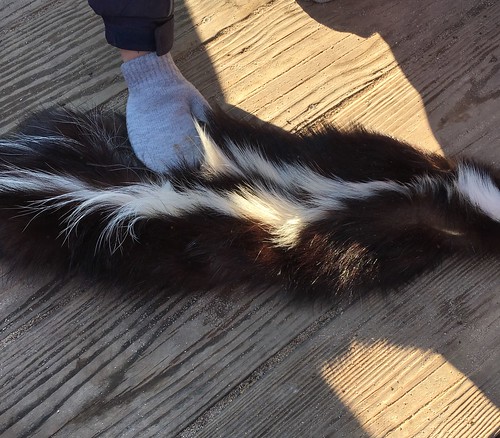
This week, for my naturalist walk at nature preschool, we talked about the two species of skunks found in Maryland: the Eastern striped skunk and the rarer, smaller Eastern spotted skunk. I brought a skunk pelt to show them, and the kids had a lot of questions.

Child Touching Striped Skunk Skin
“Turn it over!”

“What’s on the other side?”

“Where’s the bones?”

Apparently, although the kids had seen animal skulls before, they’d never seen a fur. One of their teachers explained how scientists preserve pelts of dead mammals to learn more about the animals and to teach others about them.

I pointed out that skunks have warning coloration, which is the opposite of camouflage. Instead of blending into the background, their striking black and white coloration warns other animals that they are dangerous, and not to mess with them. The scientific term for this is aposematic.

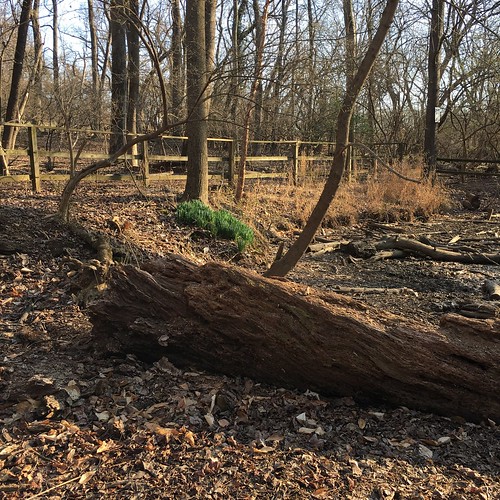
In keeping with the theme of spots and stripes, I decided that we should look for these patterns while walking. Finding stripes and spots in nature at the tail end of winter in Maryland took a little work! Frankly, everything looked brown where we were walking, with a tiny pop of color here and there.

Trees at Woodend
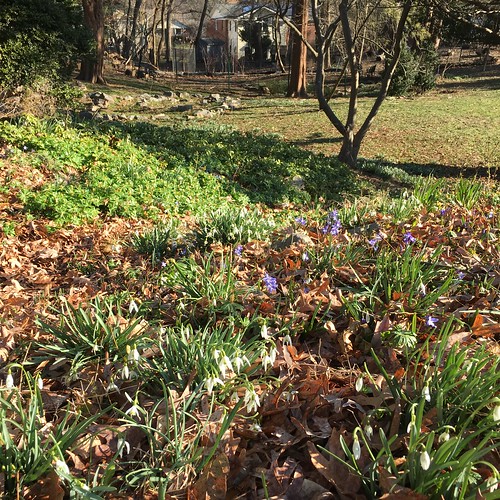
I did find spring flowers along the roadside: delicate white Snowdrops and flashy Glory of the Snow. Aren’t those great names for flowers?

Spring at Woodend
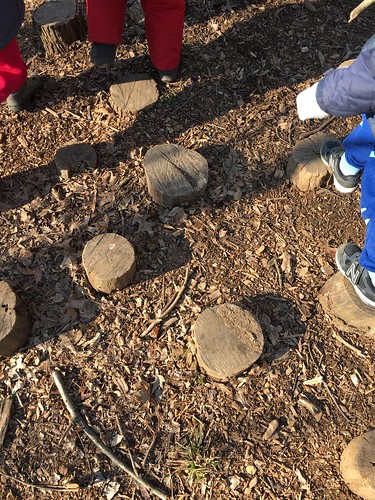
We noticed stripes in the tree rings of cut trees, along the bark of some tree trunks, and in little lines in the ice at the pond. We found spots of bird poop and in a series of tree slices.

Kids Playing on Wood Slices
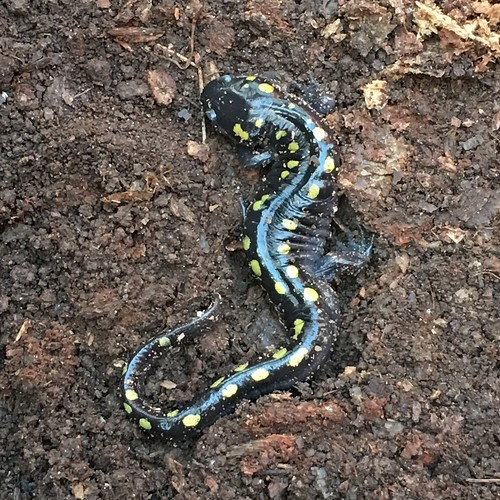
But the most exciting find came when one of the teachers rolled a rotten log** and there was a yellow-spotted salamander resting beneath it! We squealed and took pictures and one of the teachers mentioned that she was going to forward this find to another preschool class and to the scientists working at the mansion. We rolled the log back to protect the salamander. I told the kids that this was really cool because they got to be citizen scientists - everyday folks whose findings help scientists.
Yellow-spotted salamander
It was a great nature walk!

** Always remember to roll a log toward you, in case something underneath comes running out!

Thursday, March 8, 2018

Fun Facts About Flying Squirrels


There are two species of flying squirrels living in the forests of North America: southern and northern. They prefer forests with ample tree canopy.

Flying squirrels don’t really fly, they glide – like superheroes with a cape! Imagine you are wearing a blanket on your back, and it’s attached to your wrists and ankles. On a flying squirrel, this is called the patagium. It’s similar to gliding with a parachute. This article, in the Journal of Mammalogy, compares flying squirrels to hang gliders.

The tail of the flying squirrel has smooth fur and is horizontally flat. It is used as both a rudder and a stabilizer during glides.

Flying squirrels live in holes in trees or build nests of leaves and twigs. They have been known to use nest boxes and sometimes even kick birds out of their nest boxes while eating their eggs!

They store acorns for winter. They also eat fruit, other nuts, insects, and mushrooms.

Southern flying squirrels are about as common as the Eastern gray squirrel, but we seldom see them because flying squirrels are nocturnal. Notice the giant eyes in the photo below of a Carolina northern flying squirrel.

Photo credit: Corinne Diggins, Virginia Tech/USGS VCFWRU

The Carolina northern flying squirrel is an endangered subspecies of the northern flying squirrel. It lives at elevations 4,500 feet above sea level or higher. As of 2015, its habitat had been reduced to nine mountain peaks in the southern Appalachians. Scientists refer to these fragments of habitat as “sky-islands”.

Friday, January 23, 2015

A Naturalist's Thoughts on Animal Tracks in Winter

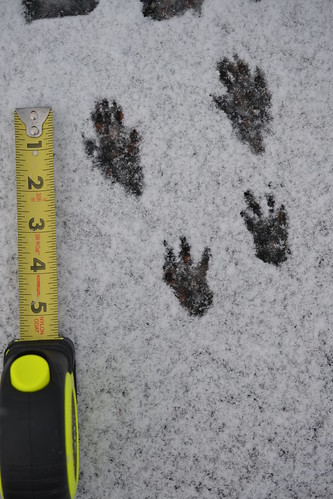
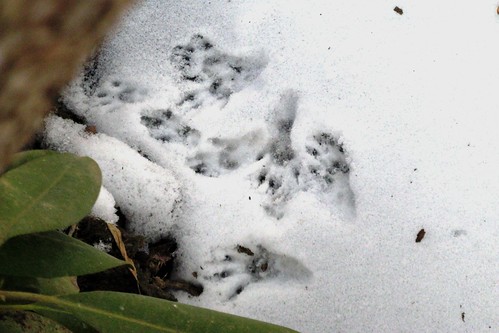
Winter, in the northern hemisphere, can be a hard time of year to spot mammals. Many are hibernating now or have significantly slowed their activities due to the cold. But fresh snowfall can lead to animal tracks, which is a fun way to study animals in winter. The following animals (and their tracks) are commonly found in the mid-Atlantic region of the United States. My thanks to vastateparksstaff for posting - and sharing - these great pictures online via Flickr (cc by 2.0). Note the use of a ruler - it's really helpful when trying to gauge the size of a print.

 White-tailed deer tracks
White-tailed deer tracks sometimes look like little hearts!

 Eastern Gray Squirrel tracks
This squirrel was running so fast that its front feet appear behind its hind feet!

HM Winter Visitors
Raccoon tracks

The text of this entry was first posted at the Audubon Naturalist Society. Come visit Woodend!

Thursday, March 3, 2011

Kemp's Ridley Sea Turtles

Photo credit: USFWS Endangered Species Program, via flickr // CC BY 2.0

I am currently taking a nature literature course. As part of my class, I'm reading The Windward Road by Archie Carr. Originally published in 1956, this engaging, scientific travelogue follows Dr. Carr as he wanders through the Caribbean islands studying sea turtles. This book drew attention to the plight of the sea turtles and their need for conservation. Today's Sea Turtle Conservancy has its origins in this book.

At the time of the book's publication, no one knew where the Kemp's Ridley sea turtle nested. People speculated that babies were born in the sea or even that it was a cross between a loggerhead and a green. Carr was puzzled by this turtle.

Reading his words, I could relate to Carr's confusion. I've always heard that the Kemp's Ridley is the rarest of all sea turtles, but I never knew why.

After publication of the book, the primary Kemp's Ridley nesting ground was finally identified by scientists - on a ten mile stretch of Mexican beach. Even today, 95% of females still nest on this beach. Imagine! No wonder they are so rare.

According to NOAA, the population of Kemp's Ridley has fluctuated but it is generally in decline. In 1947, a video recording showed 40,000 nesting females. By the mid-1980's, this number was down to 700. Thanks to conservation efforts, things were looking up for the Kemp's Ridley in the early 2000's, with almost 7,000 nests in 2003. Unfortunately, the Deepwater Horizon oil spill has further decimated the numbers of this critically endangered species. If you look at the range of where they live, you can see why. I hope and pray for their recovery.

Unlike in Carr's day, when turtles were banded with metal tags, today's turtles are monitored using satellite tracking. You can even "adopt" sea turtles! And care of injured and wounded sea turtles has greatly improved. So there is hope! Maybe I will have to take a trip over to the National Aquarium and see if I can meet some Kemp's Ridleys ...

Thursday, February 17, 2011

Get Ready for the Great Backyard Bird Count!

This week-end, Friday through Monday, marks the annual Great Backyard Bird Count, sponsored by the Cornell Lab of Ornithology and the National Audubon Society. You can contribute by watching birds in your backyard for as little as 15 minutes during one day of the count.

Last year, birdwatchers in Canada and the United States submitted more than 97,200 checklists and saw more than 602 different species of birds. The collected data is used by scientists to track migration patterns and spot trends in bird populations. In 2010, the American Robin was the bird most commonly sighted; the Red-billed Tropicbird made it onto the list for the first time.

Here's everything you need to know about how to participate. The Cornell Lab of Ornithology has an online bird guide with descriptions of 585 birds - including pictures and bird calls. If you are new to birding, you might want to start with the 51 most common bird species sighted in North America. You can also search for a birding walk or workshop in your area.

Happy birdwatching!

Friday, December 3, 2010

Informative Blogs for Animal Lovers

Want to learn more about different kinds of animals? These blogs are a great resource and include some of my favorite websites.
From common species like the American Robin to the lesser known Arapaima, Lauren shares the tidbits and insights that make each of these animals unique. Have an animal that you're curious about? You can chat with her on Twitter and suggest new animals for future blog posts.

A 110 pound Arapaima
Photo credit: Andrew Hosegood, via flickr // CC BY 2.0

I'm sorry to report that The Daily Mammal has not been updated in awhile. Nonetheless, check out the archives for Jennifer's gorgeous drawings of over 340 mammals. I hope she comes back soon and makes good on her "attempt to draw every one of the 5,000 (or so) mammal species known to science."
The Featured Creature came in 7th place in 2009's Best Animal Blogger category at the Blogger's Choice Awards and it's easy to see why. Photography is used to its full advantage here, with colorful images chosen to bring unusual animals like the banana slug up close and personal.
If you like ugly, you're in for a treat. The animals (and plants and fungi) of Ugly Overload are some of the most cringe-worthy that our planet has to offer. Check out the Reef Stonefish, with a face that's a dead ringer for Jabba the Hutt, or the red-eyed Fantastic Leaf-tailed Gecko. And I did not know that there are fish that can walk! Did you?
There's nothing cuter than baby animals and ZooBorns delivers the cuteness we crave. This blog is like an internet brag book of the world's newest babies born at zoos and aquariums worldwide. From cougar cubs to tiny Kihasa Spray Toad, you're sure to find your favorite animal babies here.

Baby Opossum
Photo credit: kthypryn, via flickr // CC BY 2.0

Tuesday, August 17, 2010

Artful Animals


This summer, my family was lucky enough to visit the Artful Animals exhibit, an accessible and friendly display of animal-themed African art at the National Museum of African Art. The engaging nature of the exhibition made me feel like creating art of my own. (Disclaimer: I actually did sit down with the kids and decorate a woven basket coloring sheet.)

The exhibit has since closed to the public, but you can still visit the animals online. We enjoyed looking for the animals in 125 pieces of art, from pottery and instruments to clothing and furniture. I loved the hands-on nature of the pieces, which included masks like the one Kerm is trying on in the photograph above.

You can listen to podcasts about some of the artwork here. Download the visually stunning Artful Animals Activity Guide (this is a .pdf file), which asks:

"What can we learn about ourselves by looking at our relationship to animals?"

"What is our place in nature and the world?"
and perhaps most importantly,
What animal would you choose to represent you?
The Artful Animals exhibit, a collaborative venture between the National Museum of African Art, the National Postal Museum, the National Zoo, and the Natural Museum of Natural History, has now closed in Washington, D.C. But the exhibit may be coming to a museum near you! Artful Animals is listed on the Smithsonian Institution's Traveling Exhibition Service, and is due to hit the road in 2012. Don't miss it!


Photo credit: Mama Joules

Friday, March 26, 2010

Kerm's Sea-Monkeys®

My older son received a Sea-Monkeys® kit for Christmas. Unbeknowst to me, he opened the package. After pouring in half of the recommended amount of water into the tank, he added the water purifier, eggs, and double the suggested amount of dried food. Nothing happened.

When I found the little tank, it was a murky green mess. I comforted Kerm and told him that we could contact the company and try again. I intended to dump out the water and clean out the tank. But, as it sometimes happens with busy moms, I promptly forgot all about it ... until a week later, when Kerm came running in to find me.

"Mommy! They hatched!"

Yes, we have a tank of Sea-Monkeys® living at our house. I think we might be on our second generation, since we have some large ones (and a couple that appear "stuck together"!) and some very teeny tiny dots that look like swimming periods.

What are they? Sea-Monkeys® are a modified species of brine shrimp designed to grow and thrive in the home. This species undergoes crytobiosis, which can be defined as a "reversibly suspended metabolic state." In short, their eggs are nearly indestructible. At this stage in their life cycle, they can survive for long periods of time without water or food.

I have mixed feelings about engineering animals for human use, particularly as novelty items. But I have to admit that, so far, I like the Sea-Monkeys®. These little guys are easy to "grow" and appear to be robust. After all, ours easily tolerated the odd conditions that Kerm threw at them.

I hope that our tank thrives for a long time. In fact, the Sea-Monkeys® website claims that a colony like ours might live for up to two years!

Photo credit: Mama Joules (Note how small they are -- that's my thumb in the bottom of the picture. The critter that you can see looks bigger than it really is because it was swimming very quickly when I took the photo.)

Thursday, December 31, 2009

Best of 2009 at Mama Joules

I've been reading a lot of "best of ..." lists for 2009 lately, so I thought I'd recap this year at Mama Joules. See what you think of these posts from 2009:


Best Ideas for Gardeners:
Grow a Science Garden

Heinz Wholesome Memories Intergenerational Garden Award

Take the Lead Out of Gardening

Best Ideas for Mixing Art & Science:
Join the Fun at One Million Giraffes

Make-A-Flake

National Gallery of Art's Lending Library

Neuroscience for Kids (includes coloring pages)

Reuse Those Old Crayons!

Best Interview:
Meet a Beekeeper!

The Intelligence of Bees: Meet a Beekeeper! Part 2

Colony Collapse Disorder: Meet a Beekeeper! Part 3

Learning to Keep Bees: Meet a Beekeeper! Part 4

Best Invention:
Flying Car

Best Opportunities for Citizen Scientists:
Ancient Tree Hunt

FrogWatch USA™

North American Moths Backyard Inventory

Project BudBurst

Best Posts About Animals:
Cricket Ears are Amazing

Giant Frog Gets New Friend - Titanoboa

Venom & Vomit: Meet the Tarantula

Best Posts About Science Poetry:
Meet Scifaiku

Science Poem: Intrasolar Interloper

The Fibonacci Poem

Best Use of LEGO®s:
Kerm's Mars Rover

Little Brother's Mars Rover

Best Post of the Year
What is Global Warming?

Have a safe and wonderful New Year! Be sure to check out these fun ways to add science to 2010!

Photo credit: Gordana Adamovic-Mladenovic,
through a Creative Commons Attribution 2.0 Generic license via Flickr.

Thursday, December 3, 2009

Venom & vomit: Meet the tarantula

Are you looking for inspiration so that you can enter the American Tarantula Society's Kids' Poetry Contest? Let's meet the tarantula!

When I was a little girl, my parents and I lived in southern California. Once, while driving along a deserted stretch of highway, my dad saw something that made him slam on the brakes. A giant spider stood in the middle of the road. It was so big that my mom and dad just sat there in shock until it crossed to the other side.

Tarantulas, the giants of the spider world, are striking. The biggest is the South American Goliath tarantula. It can grow to be over eleven inches in diameter. This spider is so large that it preys on birds! Check out this great video about Goliath tarantulas from National Geographic.

South American Goliath Tarantula


Wade Harrell, President of the American Tarantula Society, was kind enough to answer my questions about these mammoth spiders. He describes the tarantula's dietary habits like this:
"Tarantulas, like almost all spiders, are carnivores. Tarantulas inject venom to kill their prey, chew it up with their chelicerae, and then regurgitate digestive [throw up] onto it. As with all spiders, they can only eat liquids, so after the soft parts have been liquefied, the spider sucks the bug soup out and leaves a crumpled ball of bug exoskeleton."
There are around 800 different species of tarantula, mostly living in the world's warmest climates.
"The majority of tarantula species live in the tropics and subtropics, although their are some in the temperate zones," says Harrell. "They are pretty shy for the most part; most will retreat into their burrows (or arboreal retreats in the case of tree-living species) at the first sign of trouble! In many cases, humans who live within tarantula habitats are totally unaware of their presence."
Please keep in mind that people don’t die from tarantula bites. I've read in numerous (credible) places that tarantula bites are no worse than bee stings.
"In the US," says Harrell, "tarantulas are most often seen when males leave their burrows to search for mates, a one-way journey for them!"
Girl tarantulas tend to be longer lived than the boys. In the wild, some female tarantulas can live up to thirty years!

Want to learn more about tarantulas or keep one as a pet? Be sure to drop by the American Tarantula Society. There's an active discussion board where you can ask questions. ATS President Wade Harrell offers this advice to potential new tarantula owners:
"My advice to the would-be tarantula enthusiast would be to research them before purchasing. There are many species available. Some are good for the beginner, some not. Our website and discussion forums are a good starting point, and there's even a free download-able care sheet. Tarantulas are easy to keep for the most part, but you still want to know what you're getting into! Also, pet store employees usually don't know much about them, so it's best to not rely on them for information, plus they may try to sell you expensive stuff you don't need. The ease of care is one of the great things about them ... they usually don't need heat, special lights, or very much space. They also don't eat much; most keepers feed once or twice a week, and they can go months without food."
Thanks for the advice, Wade! I may not want to personally own a tarantula, but I'm a little less afraid of them now.

(Note to self: The tarantula is an arachnid, not an insect.)


Photo credit: snakecollector (John) through a Creative Commons Attribution 2.0 Generic License via Flickr.


---

[Update: 12/3/09 -- Corrected the number of tarantula species to "around 800", instead of "over 100", thanks to Wade Harrell]

Wednesday, December 2, 2009

American Tarantula Society's poetry contest for kids


Are you under the age of 18, living in the US or Canada? Do you like to write poetry about spiders and other creepy crawlies? Then I've got a contest for you!

I recently spoke with Wade Harrell, President of the American Tarantula Society, via email. He gave me permission to repost this information about ATS' current poetry contest for kids. This information comes from the ATS Discussion Board, a great resource for any tarantula enthusiast.

If you plan to enter, don't delay! The deadline for entries is December 10, 2009. If you have any questions about the contest, please direct them to Payton MacDonald (contact information below).

Good luck!

The ATS has received a generous donation to support more kids' contests ... The first contest is for original poetry. We seek two poems per entry, one a haiku and the other in a form of the applicant's choice. The content of the poems must relate to tarantulas, scorpions, and arachnids in general.

The winning entries will be chosen by a committee. The prizes are as follows:

First Place: A Nintendo Wii or Wii games
Second Place: A free year subscription to the ATS Forum
Third Place: A tarantula T-shirt

Each participant must be under 18 years of age (living in the US or Canada). Winners of an ATS contest in the last six months are ineligible. Multiple members of the same family may enter the contest. Please send submissions to the Kids’ Section editor via email if possible. Regular mail is also acceptable. Submissions must arrive by December 10, 2009.

Please submit entries to Children's Editor Payton MacDonald:
payton [dot] macdonald [at] gmail [dot] com

(replace the "dots" and "at" with the appropriate symbols)

Photo credit: Alvaro Guzman, through a Creative Commons Attribution 2.0 Generic License via Flickr.

Thursday, November 19, 2009

Butterflies on the International Space Station!

There are butterflies in space! Painted Lady larvae and three Monarch caterpillars are currently orbiting above us, after recently traveling to outer space aboard the Space Shuttle Atlantis. The "butterflynauts" boarded the International Space Station yesterday.

You can track the progress of the Painted Lady butterflies via Twitter (@ButterflySpace). Teachers can download a free teacher's guide and register for email updates about the mission. There's also a specific thread for teachers on the BioEd Online web board devoted to this experiment.

From the Butterflies in Space website at BioEd Online:
"On November 16, 2009, Painted Lady butterflies [flew] aboard Space Shuttle Atlantis to the International Space Station (ISS). The butterflies will spend several months in space as part of an exciting experiment to observe their life cycles and behaviors in microgravity. We invite your class to participate! The butterflies will live in a special habitat, which provides a safe environment, food and water. Photos and video will be transmitted back to Earth and made available here ..."
But Painted Lady butterflies aren't the only insect space travelers this time. Monarchs are up there, too! Through Monarchs in Space, Monarch Watch is documenting the progress of the monarch larvae. You can download some wonderful instructional data from this site along with links to other fun stuff like these recent pictures of the monarch caterpillars in space.

This current set of butterfly experiments builds upon previous work by BioServe Space Technologies, which has designed experiments in space since the early 1990s (including space flights for spiders, ants, and silkworms).

This video describes some of the challenges that the butterflies may face in their new habitat:


Enjoy!

Thursday, October 1, 2009

Design a poster for the National Zoo!


If you are between the ages of 8 - 14 and live in the United States, consider entering the poster contest at the Smithsonian National Zoo. Copies of the winning poster will be displayed at the zoo and at schools in the DC area. You and your poster could be honored at a special ceremony and you would win a gift basket with six tickets to this year's opening night of ZooLights!

According to the website, in order to be chosen, your poster must be the best at showing these three things:

* the Zoo is a wonderful place to see animals, trees, and plants,
* does a lot to save wildlife,
* and is always FREE.

Your poster must be at least 8.5" x 11" and no larger than 11" x 17". You can scan your work and enter online, mail in your entry (you'll need to include this entry form -- this is a .pdf file), or you can hand in your work at the Visitor's Center at the zoo. Contest entries must be received by November 12, 2009 and you can enter more than once.

Good luck!

Wednesday, September 23, 2009

Learn about local wildlife in Millbury, MA

Photo credit: dawnzy58, through a
Creative Commons Attribution 2.0 Generic license via Flickr.


My friend Michele asked me to help get the word out about two free sets of classes that she's teaching on local wildlife identification through Massachusetts' Millbury Public Library. The outdoor sessions will likely include visits to the Blackstone Bike Trail, Davidson Bird Sanctuary, and Deering Estate.
The Art of Seeing

Workshop for learning about local wildlife and the signs they leave behind.

Session 1:
Wednesday Sept 30 at 6:30pm and Sunday Oct 4 at 1pm

Session 2:
Wednesday Oct 7 at 6:30pm and Sunday Oct 10 at 1pm

(Wednesdays at the Millbury Public Library; Sundays at a local open space in Millbury)

The indoor session will focus on how to start and keep a nature journal as well as basic information on identification of birds, flowers and trees. Our outdoor session will focus on using our new skills.

Participants will be required to supply their own field journal, pens or colored pencils, water bottles, snacks and transportation to the site. Carpooling will be encouraged.

To reserve your place, contact the Millbury Public Library at (508) 865-1181. For more information, please contact MicheleDecoteau[at]verizon[dot]net.

I wish I lived closer so that I could attend! Happy trails, Michele!

Tuesday, September 22, 2009

Today is Elephant Appreciation Day!


Happy Elephant Appreciation Day! Some places, like the Phoenix Zoo, are holding special elephant-themed events today. So, get out there and visit an elephant! Or, if you're stuck inside, surf over to the San Diego Zoo's elephant cam or check out the pics of the newest baby elephant at Utah's Hogle Zoo. You can even purchase trunk-painted artwork online by one of the great elephant artists at the Knoxville Zoo!

P.S. My thanks to my friend Vanessa for letting me know!


Photo credit: Brian Snelson, though a Creative Commons Attribution 2.0 Generic license via Flickr.

Monday, August 24, 2009

Join the fun at One Million Giraffes!

Join thousands of people across the globe as we try to help Norway's Ola Helland win a bet with his friend Jørgen: Can he convince people to post one million handmade giraffes on his website, One Million Giraffes, within a year's time?

My friend Tanja pointed me toward this project, which has gone viral on the web through Twitter and Facebook. Helland is even starting to pick up round-the-world media coverage with groups throwing giraffe-drawing parties! What touched me about this idea, though, are the actual drawings. People from over 80 countries have submitted more than 100,000 photos of their giraffe creations since the project started 74 days ago. Helland showcases some of the most unique creations in his blog, including a giraffe made out of cake and one made out of human hair! But most of the giraffes are simple drawings, created by people from all stripes of life, revealing their connections with this iconic zoo animal.

How do you take a simple idea and make it better? According to the Telegraph.co.uk, Helland is currently looking for a corporate sponsor to donate money per drawing to World Wildlife Fund to aid in giraffe conservation.

Want to join in the fun? Read the official rules and upload your creation! Here's a clip to inspire you:

Friday, August 7, 2009

Website of the Week: FrogWatch USA™


Do you like frogs? Enjoy studying wildlife? Then join FrogWatch USA™, "a Citizen Science Monitoring Program" currently hosted through the National Wildlife Federation but soon to be part of the Association of Zoos and Aquariums.

Frogwatching season generally runs February through August. Once you learn how to frogwatch and register your study site (hey, I'm thinking maybe I could register my backyard next year!), you gather your frogwatching materials, record your data (weather conditions and frog calls) and submit it on a regular basis to FrogWatch USA™.

You will be helping scientists to figure out why amphibian populations are declining. After scientists identify some of the problems facing frogs, they can work on solutions to help save them. At the same time, you will get more in touch with nature through your study site. And you will learn to identify frogs from their calls.

I had no idea that frog calls were so diverse! eNature has a great page with frog and toad calls. I couldn't help myself - I started hitting all of the "listen" buttons at once. Soon, a whole symphony of voices filled my living room. It is amazing how the calls are so different. I can understand why it might be easier to identify a frog by sound than by sight.

If you are not in the United States, you still should be able to join a frogwatch in your area. For example, FrogWatch Saskatchewan is looking for volunteers, and check out Frog Atlas Australia.

Happy frogwatching!


Photo credit: Topato through a Creative Commons Attribution 2.0 Generic license.

Monday, August 3, 2009

S-s-s-s-something else in our backyard

Last week, during our frog-finding expedition in the backyard, Kerm and I spotted this:


and this, which is actually part of the same thing:


Do you know what it is? Yep, a snake skin. Some snake was likely hunting the little frogs that live in our backyard and, while slithering between our green garden hose and the heating & cooling unit, it shed its skin.

I took a rake and carefully peeked under all of the foliage in our backyard, but I saw no sign of the snake. Most snakes are rather shy, so that's not surprising. But I wanted to find out what kind of snake the skin came from. Was a venomous snake prowling around in my backyard?

Probably not. I gathered up all of the skin that I could find, about 18 to 24 inches of it, and put it in a box. It was all in a single piece, but it was so fragile that it tore when I picked it up.


One thing I do know: this didn't come from a venomous snake. I researched snakes and found that there are only two venomous snakes near where I live. Both of these snakes have highly patterned markings on their skins. You can tell that this snake does not, although it might have lateral stripes. See how the skin is darker along the sides?

I'd like to take this snake skin to a nature center near where I live and see if they can tell me more about its former owner. Do you know what kind of snake has been living in my backyard?


Photo credits: Mama Joules

Friday, July 31, 2009

Friday Fun: Find the frogs

Here are two photographs from my recent backyard frog-spotting expeditions with Kerm. Can you find the frogs? They like to hide!

(Note: You can zoom in on the second image and get a pretty good look at the frog. See its striped legs? I wonder if it really is a Spring Peeper? I can't find pictures of any frogs common to my region that look quite like that.)