Showing posts with label parenting. Show all posts

Sunday, March 18, 2018

Using Crafts to Teach Science (Science Literacy Series #2)

Rubber Band Bracelets
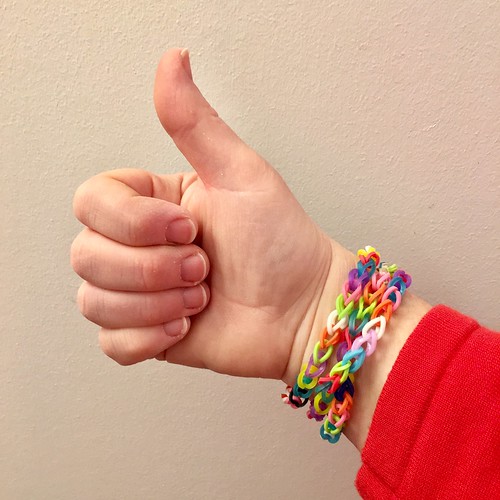
My 9-year-old daughter’s latest obsession is making jewelry from tiny, colorful rubber bands. I’m a firm believer in integrating science education into whatever subject interests a person. So, how could you approach this with crafting?

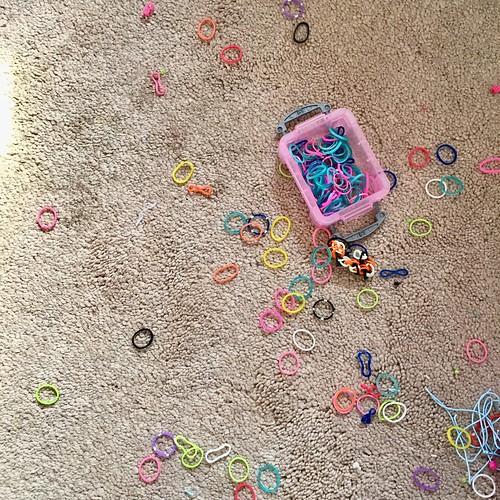
In my daughter’s case, she is a messy crafter. Her floor is currently littered with tiny rubber bands. This presents the perfect opportunity to teach about the theory of evolution, namely camouflage (Which rubber bands blend into the carpet?) and the mechanism of natural selection (Which color bands are the easiest to detect? If you were a predator, these prey would be caught first and wouldn’t have a chance to reproduce.).
Rubber Band Bracelet Supplies
Another on-ramp to science would be to discuss the rubber itself. What is rubber anyway? Is it an element? What’s the difference between natural and synthetic rubber? How was rubber first discovered? What else is made of rubber?

You don’t have to know the answers. You and your child can have fun looking them up together. This is the start of scientific inquiry. Scientific research sounds impressive, but all it really means is this: “Research conducted for the purpose of contributing towards science by the systematic collection, interpretation and evaluation of data...” - Turkish Journal of Anaesthesiology and Reanimation.

Scientists are simply curious people who keep asking questions long after others grow bored with the topic. If you can find the right hook to grab a person’s attention, you can make science relevant to (almost) anyone.

Maybe, instead of jewelry, the young crafter in your life likes to use a hot glue gun. This is a great time to talk about the states of matter. Why is the glue now more liquid than solid? What changed? You can introduce the idea that there are more than three states of matter, and that new states of matter are still being discovered!

Collecting natural materials, like pine cones, for crafting can be a nice chance to talk about the types of plants and animals that live in your community. How have they adapted to the climate in your area? For example, some pine trees have serotinous cones that are sealed with resin and require the heat of a fire to release their seeds! (Be sure to bake any pine cones you collect in a low heat oven [200 degrees F] for about 20 minutes before using them. This both kills any insects present and helps to open up the scales.)

Constructing new items out of (relatively clean) waste materials is a great opportunity to introduce the concepts of reduce, reuse & recycle. What happens to our garbage? Can we make crafts from household waste? I went to one training where we were instructed to build a bird out of paper scraps, pipe cleaners, cardboard, and small cans. The only new materials introduced were feathers, glue, and googly eyes. All of our craft birds were so different! This led to an interesting discussion about avian anatomy.

Have you ever used crafts to teach about science? Please share your thoughts in the comments!


Wednesday, April 15, 2015

Science Literacy Starts at Home (Science Literacy Series #1)

I think the way we talk about science in this country is flawed. Too often, I hear people speak of science as a subject in school, rather than an integral part of daily life. If we want our children to be literate in science, we need to change the way that we approach the subject.

I once had a discussion with another mother in which I spoke of my love of taking my son to our local nature center.

"Oh," she said. "I don't do that. My husband does the science."

That statement of hers has bothered me ever since. It's not that she doesn't like science - I can appreciate that some people don't. It's that she is modelling the idea that science is somehow separate from the rest of her life - as if science is simply a concept that you can graft on at a later date.

Science needs to be integral to a child's life from the beginning. And by this, I mean that we - as parents - approach teaching our children with science literacy in mind.

1) Ask the what if questions. What if the sky was red instead of blue? What if we dropped this egg from the top of that building? What happens when we microwave marshmallow Easter candy? (Goal: encourage curiosity, thinking outside of the box)

2) Challenge popular thinking. Why does everyone love pop star of the moment? What makes him or her so special? Why should we buy that brand of toothpaste? What is that commercial really trying to sell us? (Goal: critical thinking)

3) Observe your surroundings. What makes this dancer better than the others? Is it the way he moves? The way he uses the space on the dance floor? How he carries himself? (Goal: observation skills, concentration) 

What do you think? How do you encourage science literacy at home?


Wednesday, October 23, 2013

How to Choose a Field Guide for a Young Child

A couple of days ago, I went to a nature store to purchase a field guide for my youngest, who is fascinated by butterflies. The store had a terrific selection, so I asked the clerk where I could find field guides for little kids.

"How old is the child?"

"Four."

"Oh, we don't carry field guides for children that young."

I thought this was a bizarre response. At its most basic level, a field guide is a collection of pictures or drawings of a given set of plants, animals, or other natural features (rocks and clouds are among my favorites). Sure, you can buy guides with lots of text and exposition about various features, but you don't have to.

Here are some basic guidelines for buying a field guide for the very young child:

  • Choose a guide that is small enough for little hands to hold. Make sure the book isn't too heavy or too thick. I like Stokes Beginner's Guides. 
  •  Pick a guide where the specimens are arranged by color. This type of grouping is easy to explain and understand. Pictures will capture the attention of a little one better than drawings. My daughter, for example, loves the section of her new guide devoted to swallowtails. "We've seen that one, and that one, and that one!" she said.
  • Choose a book with common specimens over rare ones. Let's face it - little kids are noisy and boisterous and will scare away much of the wildlife you are trying to study. Pick a field guide that is heavy on natural things that are common for your area since you are far more likely to see them.
  • Less is more. Pick a guide with just a few features on a page. A large picture of the specimen coupled with a map showing its range is ideal. Symbols for common features are better than words. For example, it's better to show one star out of five to indicate a rare species than the word "rare."

Regardless of which guide you choose, make sure to have your child take ownership of the new book. Write his or her name on the cover - or let your child do it - and find a special place for it on the bookshelf. When you go outside for a nature walk, take your comprehensive guide along with your child's smaller one, and you can have fun discovering nature together.


Princess likes her new field guide.

Wednesday, January 13, 2010

Meet Jupiter's Mother (Part 2)


Today, we welcome back Tracy Zollinger Turner, of Tiny Mantras. Tracy is the mother of a four-year-old astronomer (above) and has been sharing her tips for encouraging a child's love of science. You can read the first part of our interview here.

***

Welcome back to Mama Joules, Tracy! I've gathered from reading your blog that astronomy was not one of your primary interests prior to your son falling in love with Jupiter (and the rest of the universe). How do you foster your son's love of astronomy?
For someone like me, I think remembering the connection between art and science (or science and everything!) has been helpful. I bring the science he likes into projects I enjoy more. We make planets and galaxies and nebulas out of clay. Or we do things like make egg tempera paint and encourage color mixing so there's a scientific process that's part of painting.

Tracy and her son made these planets and stellar objects
out of Play-Doh and FIMO clay.


I've promoted his interest in letters and reading by spelling and helping him write space-related words (we have used so many space metaphors in this house). When you actively notice what your child responds to, it gets easier to realize that shimmery fabrics can be used for imaginative play when he feels like being a comet or a black hole, crystals that hang in the window make rainbows around the house, and that it's okay for an apple to be sacrificed in the name of understanding gravity now and then.
What suggestions (for websites, books, etc.) do you have for parents of other would-be astronomers?
Websites

There are plenty of great astronomy sites out there, but few of them have stuff for younger kids. I like KidsAstronomy.com. There are science songs and reasonably simple games there.

Television, Music & Books

[My son] loves watching Powers of Ten, which may be one of the best videos ever made when it comes to illustrating the vastness of the universe, as well as the microverse! The TV show Zula Patrol is actually pretty great [too].

They Might Be Giants CD, "Here Comes Science" is our new soundtrack around here. It's actually taught or reminded me of a number of basic [scientific] concepts.

I wrote a post a while back about some of the astronomy books for kids that I like. [Note from Mama Joules to Tracy: Kerm reviewed George's Secret Key to the Universe; he thought it was great!]

Places to Visit

We've used Google Earth a lot to find our house, and [my son's] favorite places nearby from space. Incidentally, his favorite places are...

COSI - our local science center

Perkins Observatory - where the telescope was formerly the most high-powered in Ohio and used for astronomical research. It's now an educational center with lots of old-school astronomy displays, and lots of volunteer amateur astronomers who love to help people of any age develop a love of space and telescopes.

We have had the chance to go to a couple of NASA sites - one was a rare open house. [NASA scientists] are really good at figuring out how to talk to and educate kids!

Of course, we want to take him to Adler Planetarium in Chicago, Hayden Planetarium in NYC, the Air and Space Museum in DC and any [other] NASA site that we can, but we haven't had the chance just yet.

Tracy, those are some wonderful suggestions. I know that I will be visiting those websites soon. Thank you so much for stopping by!

***


If you'd like to contact Tracy, or read further about her adventures with her astronomy-loving preschooler, please visit her at her blog, Tiny Mantras. She is also the occasional host for the Carnival of Space, a must-read if you want to keep up with astronomy in the blogosphere.


Photo credits: Tracy Zollinger Turner (used with permission)

Monday, January 4, 2010

Meet Jupiter's Mother

Happy New Year! I'm pleased to welcome Tracy Zollinger Turner, of Tiny Mantras, to Mama Joules. In a recent issue of the Carnival of Space, she described her relationship with astronomy like this:
"[My son's] interest in space has been unyielding for as long as he's been able to talk. Therefore, I spend a lot of time reading astronomy blogs to try and become more scientifically literate, as well as riding imaginary space elevators out to Proxima Centauri and other stars in search of exoplanets. And smoothing flour and cocoa powder in a large bin so my son can throw rocks in it and make craters. Or making special trips to Big Lots to buy a bright yellow bucket for a $1 so he can keep his pretend meteor collection safe. You get the idea."
I was fascinated by her description. Reading further into her blog, I discovered that Tracy's son has a special affinity for Jupiter, and has even dressed up as the planet for Halloween.

Jupiter goes trick-or-treating
Photo credit: Tracy Zollinger Turner (used with permission)

When thinking of blog topics for Mama Joules, I often focus on how to engage a child's love of science. But Tracy's blog got me thinking: How do parents and educators sustain a child's interest in a scientific topic, especially when his or her fascination goes beyond our own? So, I invited Tracy to Mama Joules for a visit.

***

Today, we welcome Tracy Zollinger Turner, of the blog Tiny Mantras, for a chat about raising scientifically literate children. Tell us about yourself, Tracy.

I'm a longtime freelance writer and editor, technology lover, journalist, blogger, art and music appreciator, wife, mother, home-based career woman, learner.
You write in Tiny Mantras that you are "mother to a fanantical four-year-old astronomer." When did you realize that your son's interest in outer space was unusual for his age?
It's been a consistent interest for as long as he has been able to speak. When he was about a year-and-a-half old, he learned words in groups - colors, shapes, animals. Since he just seemed drawn to spheres and pictures of planets, he learned the solar system next.

I think I kind of always realized it was unusual. I do remember it really hit home for me when we went to the bookstore on his second birthday and he pointed at a big coffee table book up high on a shelf and said, "Get the 'bero galaxy book, Mommy." I pulled the thing down, looked at the inside flap, and found out that the picture on the cover was of the Sombrero Galaxy, which I wouldn't have known.

Sombrero Galaxy as seen by the Hubble Space Telescope.
Image courtesy of NASA

He either picked it up through the space documentaries we were watching ("The Universe" on the History Channel was in its first season) or one of the space books we had begun to accumulate. At the time, he was far more interested in books full of space telescope images than space books that were created for kids.

I have always been prepared for him to lose this interest or move on to something else. Other parents told me that sometimes two-year-olds get really into something then forget all of the details they once knew as they move on to other things. At times, he's gone pretty deeply into learning about other (usually science-y) things, like anatomy and weather, but now, at four and a half, space still prevails.
Do you have any tips for how to encourage children to love science, especially when their interest in a specific topic exceeds your own?
I let his questions lead me. I learn a lot of this stuff with him. Like a lot of people - and women, especially - I grew up thinking that I didn't have much of an aptitude or love for science, and one of my son's real gifts to me has been teaching me that I actually do!

With a couple of exceptions, I don't think that most of my elementary or high school teachers knew how to make science relevant to students' lives. Yet it is so relevant and so common, and can be so much less intimidating than we make it. I see a lot of parents tripped up thinking that they have to know something to teach it, when learning it together - giving them some of the power to realize that grown-ups don't have all the answers - can make it so much more memorable for the child.

When I want to set [him] up with something I don't have to help a lot with, there are so many great resources and ideas out there when it comes to creating projects and experiments. Like putting flour and cocoa powder at the bottom of a big plastic bin, smoothing it, then letting him throw rocks in there to see what happens when meteors hit the moon, or Mercury.
Thanks, Tracy, for giving us such wonderful suggestions for making science fun!

***

You can learn more about Tracy's adventures raising her mini-astronomer at her blog, Tiny Mantras. Join us next week as Tracy shares some of her family's favorite astronomy websites and places to visit!

Friday, December 19, 2008

Website of the Week: GeekDad.com

This week's website is for the parents. Check out GeekDad.com, the parenting blog at Wired. These blog entries are written by various geek-dads and moms -- fellow science-loving parents who enjoy their Roombas (those cool little robot vacuum cleaners), Christmas-themed LEGO®s, bizarre science news (students launching teddy bears into space!), and wonder how many helium balloons it would take to carry away a child (Answer: We can all breathe easier -- according to this post it would take over 1,000 filled balloons to lift the average two-year-old).

If you're still pondering your holiday shopping list, check out GeekDad's Holiday Gift Guides, including recommendations for Toys for Dads & Kids to Share, Kids' Books & Activities, and even gifts for GeekMoms!

Wednesday, December 3, 2008

Silly quiz: Do you think like a scientist?

So, maybe you’re reading this blog and you’re wondering, do I think like a scientist? Do I parent like a scientist? Here’s one (highly informal and irreverent) survey to help you decide:

1. When a bug lands in your soda, do you:

  1. Throw the can away.
  2. Think to yourself, “Wow, I need to look that up in my insect identification book!”

2. Your daughter comes into the house covered in dirt. Do you:

  1. Order her to take off her shoes and head to the nearest bathtub.
  2. Have her collect a sample of soil from the floor and rub it between her fingers to check the texture.

3. The news channel warns of an impending tornado. Do you:

  1. Go to the basement or an interior room.
  2. Grab your camera and head outside.

4. You turn your back for five minutes and your 3-year-old son has mixed flour, cinnamon, Kool-Aid, and something else into an unidentifiable goo. He is now holding the bowl in one hand and smearing this mixture on the walls with the other. Do you:

  1. Immediately throw the bowl in the trash.
  2. Let him test his hypothesis that the goo will stick to the walls before you take his bowl away.

5. You are reading this survey and imagining these scenarios actually taking place. Do you:

  1. Feel an immense sense of relief that this isn’t happening at your house.
  2. Wish the survey was longer so you’d have more ideas to try. ;-)

Monday, June 2, 2008

Mama Joules' Young Birder

Kerm Takes Aim

Photo credit: Mama Joules

Way to go, Kerm! Mama Joules’ sometimes guest blogger and favorite resident six-year-old has won a copy of The Young Birder’s Guide to Birds of Eastern North America by Bill Thompson, III from our friends at 10,000 Birds. You can read Kerm’s winning essay along with some wonderful tips for engaging young birders at How to Get Kids Excited About Birds.

But if you want to encourage a child’s interest in nature and seem to have hit a brick wall, I have an interesting story for you. This is what actually happened when Kerm and I sat down to write his birding essay:

“Why do you like birding?” I asked, expecting a quick answer.

He looked at me blankly and started to fidget. “I don’t know.”

“Well,” I said, gently. “Why did you start birding?”

“You made me.”

Ouch! Is that true? I felt my stomach lurch. Did I really *make him* go birding? I thought back to when I had purchased his first bird identification guide. He was so small that he could barely write his name inside the cover. Does he even like birding? Maybe he’s been faking it all this time.

I took a deep breath and tried a different tactic. “What’s fun about birding?”

This time his face lit up and a torrent of words rushed out. “I like the sounds that birds make and I like their colorful feathers …” He then proceeded to tell me all about bird calls and different types of plumage.

As I sat back and listened, I was struck by the awesome power of the words that we speak to our children. For me, there was no difference between these two questions about birding. But for Kerm, one sentence led to a brick wall. The other opened the door of communication.