Showing posts with label blogs. Show all posts

Friday, December 3, 2010

Informative Blogs for Animal Lovers

Want to learn more about different kinds of animals? These blogs are a great resource and include some of my favorite websites.
From common species like the American Robin to the lesser known Arapaima, Lauren shares the tidbits and insights that make each of these animals unique. Have an animal that you're curious about? You can chat with her on Twitter and suggest new animals for future blog posts.

A 110 pound Arapaima
Photo credit: Andrew Hosegood, via flickr // CC BY 2.0

I'm sorry to report that The Daily Mammal has not been updated in awhile. Nonetheless, check out the archives for Jennifer's gorgeous drawings of over 340 mammals. I hope she comes back soon and makes good on her "attempt to draw every one of the 5,000 (or so) mammal species known to science."
The Featured Creature came in 7th place in 2009's Best Animal Blogger category at the Blogger's Choice Awards and it's easy to see why. Photography is used to its full advantage here, with colorful images chosen to bring unusual animals like the banana slug up close and personal.
If you like ugly, you're in for a treat. The animals (and plants and fungi) of Ugly Overload are some of the most cringe-worthy that our planet has to offer. Check out the Reef Stonefish, with a face that's a dead ringer for Jabba the Hutt, or the red-eyed Fantastic Leaf-tailed Gecko. And I did not know that there are fish that can walk! Did you?
There's nothing cuter than baby animals and ZooBorns delivers the cuteness we crave. This blog is like an internet brag book of the world's newest babies born at zoos and aquariums worldwide. From cougar cubs to tiny Kihasa Spray Toad, you're sure to find your favorite animal babies here.

Baby Opossum
Photo credit: kthypryn, via flickr // CC BY 2.0

Friday, March 12, 2010

Website of the Week: Let's Paint Nature!

It's been a while since I've written up a Website of the Week, but Let's Paint Nature! deserves a special nod. I love the topic -- combining nature and art -- and I think it's great that the artist, Christine Kane, donates 10% of her artwork sales to a local food pantry.

The best part about Let's Paint Nature!, however, is the juxtaposition of nature photography with nature painting. Christine doesn't just show you her work. She lets you in on the creative process. You get to see the image that inspired the art, along with photos of the artwork in progress.

Let's Paint Winter Woods! is quite striking. I was fascinated by the artist's use of deep blues and purples early in the work, which faded to shadows later when she covered them up with snow.

Check out the Learn How to Paint page for more detailed step-by-step instructions of how to paint landscapes, wildlife, and plants or head to the gallery to buy a pastel or watercolor for your wall.

Wednesday, January 13, 2010

Meet Jupiter's Mother (Part 2)


Today, we welcome back Tracy Zollinger Turner, of Tiny Mantras. Tracy is the mother of a four-year-old astronomer (above) and has been sharing her tips for encouraging a child's love of science. You can read the first part of our interview here.

***

Welcome back to Mama Joules, Tracy! I've gathered from reading your blog that astronomy was not one of your primary interests prior to your son falling in love with Jupiter (and the rest of the universe). How do you foster your son's love of astronomy?
For someone like me, I think remembering the connection between art and science (or science and everything!) has been helpful. I bring the science he likes into projects I enjoy more. We make planets and galaxies and nebulas out of clay. Or we do things like make egg tempera paint and encourage color mixing so there's a scientific process that's part of painting.

Tracy and her son made these planets and stellar objects
out of Play-Doh and FIMO clay.


I've promoted his interest in letters and reading by spelling and helping him write space-related words (we have used so many space metaphors in this house). When you actively notice what your child responds to, it gets easier to realize that shimmery fabrics can be used for imaginative play when he feels like being a comet or a black hole, crystals that hang in the window make rainbows around the house, and that it's okay for an apple to be sacrificed in the name of understanding gravity now and then.
What suggestions (for websites, books, etc.) do you have for parents of other would-be astronomers?
Websites

There are plenty of great astronomy sites out there, but few of them have stuff for younger kids. I like KidsAstronomy.com. There are science songs and reasonably simple games there.

Television, Music & Books

[My son] loves watching Powers of Ten, which may be one of the best videos ever made when it comes to illustrating the vastness of the universe, as well as the microverse! The TV show Zula Patrol is actually pretty great [too].

They Might Be Giants CD, "Here Comes Science" is our new soundtrack around here. It's actually taught or reminded me of a number of basic [scientific] concepts.

I wrote a post a while back about some of the astronomy books for kids that I like. [Note from Mama Joules to Tracy: Kerm reviewed George's Secret Key to the Universe; he thought it was great!]

Places to Visit

We've used Google Earth a lot to find our house, and [my son's] favorite places nearby from space. Incidentally, his favorite places are...

COSI - our local science center

Perkins Observatory - where the telescope was formerly the most high-powered in Ohio and used for astronomical research. It's now an educational center with lots of old-school astronomy displays, and lots of volunteer amateur astronomers who love to help people of any age develop a love of space and telescopes.

We have had the chance to go to a couple of NASA sites - one was a rare open house. [NASA scientists] are really good at figuring out how to talk to and educate kids!

Of course, we want to take him to Adler Planetarium in Chicago, Hayden Planetarium in NYC, the Air and Space Museum in DC and any [other] NASA site that we can, but we haven't had the chance just yet.

Tracy, those are some wonderful suggestions. I know that I will be visiting those websites soon. Thank you so much for stopping by!

***


If you'd like to contact Tracy, or read further about her adventures with her astronomy-loving preschooler, please visit her at her blog, Tiny Mantras. She is also the occasional host for the Carnival of Space, a must-read if you want to keep up with astronomy in the blogosphere.


Photo credits: Tracy Zollinger Turner (used with permission)

Monday, January 4, 2010

Meet Jupiter's Mother

Happy New Year! I'm pleased to welcome Tracy Zollinger Turner, of Tiny Mantras, to Mama Joules. In a recent issue of the Carnival of Space, she described her relationship with astronomy like this:
"[My son's] interest in space has been unyielding for as long as he's been able to talk. Therefore, I spend a lot of time reading astronomy blogs to try and become more scientifically literate, as well as riding imaginary space elevators out to Proxima Centauri and other stars in search of exoplanets. And smoothing flour and cocoa powder in a large bin so my son can throw rocks in it and make craters. Or making special trips to Big Lots to buy a bright yellow bucket for a $1 so he can keep his pretend meteor collection safe. You get the idea."
I was fascinated by her description. Reading further into her blog, I discovered that Tracy's son has a special affinity for Jupiter, and has even dressed up as the planet for Halloween.

Jupiter goes trick-or-treating
Photo credit: Tracy Zollinger Turner (used with permission)

When thinking of blog topics for Mama Joules, I often focus on how to engage a child's love of science. But Tracy's blog got me thinking: How do parents and educators sustain a child's interest in a scientific topic, especially when his or her fascination goes beyond our own? So, I invited Tracy to Mama Joules for a visit.

***

Today, we welcome Tracy Zollinger Turner, of the blog Tiny Mantras, for a chat about raising scientifically literate children. Tell us about yourself, Tracy.

I'm a longtime freelance writer and editor, technology lover, journalist, blogger, art and music appreciator, wife, mother, home-based career woman, learner.
You write in Tiny Mantras that you are "mother to a fanantical four-year-old astronomer." When did you realize that your son's interest in outer space was unusual for his age?
It's been a consistent interest for as long as he has been able to speak. When he was about a year-and-a-half old, he learned words in groups - colors, shapes, animals. Since he just seemed drawn to spheres and pictures of planets, he learned the solar system next.

I think I kind of always realized it was unusual. I do remember it really hit home for me when we went to the bookstore on his second birthday and he pointed at a big coffee table book up high on a shelf and said, "Get the 'bero galaxy book, Mommy." I pulled the thing down, looked at the inside flap, and found out that the picture on the cover was of the Sombrero Galaxy, which I wouldn't have known.

Sombrero Galaxy as seen by the Hubble Space Telescope.
Image courtesy of NASA

He either picked it up through the space documentaries we were watching ("The Universe" on the History Channel was in its first season) or one of the space books we had begun to accumulate. At the time, he was far more interested in books full of space telescope images than space books that were created for kids.

I have always been prepared for him to lose this interest or move on to something else. Other parents told me that sometimes two-year-olds get really into something then forget all of the details they once knew as they move on to other things. At times, he's gone pretty deeply into learning about other (usually science-y) things, like anatomy and weather, but now, at four and a half, space still prevails.
Do you have any tips for how to encourage children to love science, especially when their interest in a specific topic exceeds your own?
I let his questions lead me. I learn a lot of this stuff with him. Like a lot of people - and women, especially - I grew up thinking that I didn't have much of an aptitude or love for science, and one of my son's real gifts to me has been teaching me that I actually do!

With a couple of exceptions, I don't think that most of my elementary or high school teachers knew how to make science relevant to students' lives. Yet it is so relevant and so common, and can be so much less intimidating than we make it. I see a lot of parents tripped up thinking that they have to know something to teach it, when learning it together - giving them some of the power to realize that grown-ups don't have all the answers - can make it so much more memorable for the child.

When I want to set [him] up with something I don't have to help a lot with, there are so many great resources and ideas out there when it comes to creating projects and experiments. Like putting flour and cocoa powder at the bottom of a big plastic bin, smoothing it, then letting him throw rocks in there to see what happens when meteors hit the moon, or Mercury.
Thanks, Tracy, for giving us such wonderful suggestions for making science fun!

***

You can learn more about Tracy's adventures raising her mini-astronomer at her blog, Tiny Mantras. Join us next week as Tracy shares some of her family's favorite astronomy websites and places to visit!

Thursday, October 15, 2009

What is global warming?

Climate change is impossible to avoid. Scientists know that the Earth has been both colder (think Ice Ages) and warmer (the days of Titanoboa) at different times in the past. When people talk about the problem with climate change, though, they are talking about the recent, rapid increase in temperature across the planet. The majority of scientists think that the rate of change is unnaturally fast because of things people are doing, like burning fossil fuels (such as gasoline and coal).

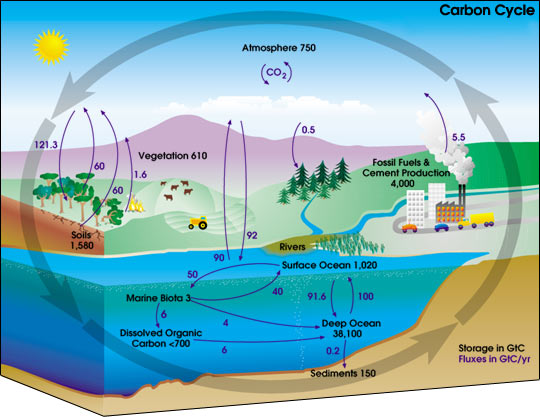
Why does burning gasoline make a difference to the planet? When talking about climate change, it helps to remember that the Earth is a closed system. We only have so much carbon on our planet. Some of it is in solid form -- carbon-based life forms like you and me and the trees outside -- and some of it is in the atmosphere in gases like carbon dioxide (CO2) or methane (CH4).

When we burn fossil fuels, carbon that was in a solid form is released and enters the atmosphere. Atmospheric carbon can then be "breathed in" by trees, grasses, and other plants to enter a solid form again. This is a rather simplified version of the carbon cycle. (In the real-life model, there's a bunch of carbon "missing" -- unaccounted for in the cycle -- and no one knows exactly where it is going [although forests seem a likely place]. But that's a topic for another blog post!)

Image credit: NASA, revised version obtained through Wikipedia Commons

The problem with the carbon cycle is that we are changing the ratio of solid carbon to gaseous carbon. When we use drive a car, cut down trees, or burn coal to heat our house, we are moving carbon to the atmosphere. Carbon isn't leaving the atmosphere as fast as it's entering it. And that's a problem.

Carbon dioxide, along with other gases in the atmosphere, acts like a shield. The sun's rays deliver heat to the Earth's surface, but the heat gets trapped in the atmosphere. Just like in a greenhouse, this reflected heat bounces back down to the earth's surface. This warms the Earth, which is a good thing because it keeps us from freezing. But adding too much carbon dioxide to the mix makes the Earth's atmosphere trap too much heat, which causes temperatures to rise. This is known as the greenhouse effect.

Image credit: NASA (taken from a 2002 online press release)

Scientists that study the atmosphere can show that the levels of carbon dioxide in the atmosphere are steadily and rapidly increasing. No one knows for sure how the Earth will adapt to these changes.

Image credit: Dr. Pieter Tans, NOAA/ESRL (www.esrl.noaa.gov/gmd/ccgg/trends)

Think of the earth as a big mixing bowl. The sun's rays are beating down on the Equator, heating up the middle of the planet, while the poles are cold and snow-capped. These differences in temperature drive our weather.

Now, let's say that global warming has increased temperatures around the world. This may not seem like much of a problem at first, especially if you hate winter. But here are three specific concerns:

1) The Earth's weather is going to change. The polar ice caps are melting. The mechanism that drives our weather -- these differences in temperature across the globe -- has been altered. The ratio of the earth's liquid water to ice has changed. These changes are affecting the world's weather. And we have little control over the changes.


South Cascade Glacier, Washington State, United States.


Photo on top taken in 1928, photo on bottom from 2006. Note that the lower part of the glacier has melted by 2006.


Photo credits: 1928 - USDA/USGS; 2006 - USGS, cropped by Mama Joules)


Weather is not easy to predict as it is. Adding more confusion isn't going to help us develop good climate models. Although we have ideas, we don't know exactly how the weather is going to change from increased temperatures. As anyone who's watched a weather forecast knows, climate models can only predict so much.

Sometimes, a model completely fails to guess what's going to happen. Climate models are at risk of failure because so many factors (even the amount of volcanic ash in the sky) drive climate change. We know that weather can cause big problems -- things like typhoons, tornadoes, flooding, and drought. If we can't plan for the future, we will be unprepared for disaster when it strikes.

2) Some plants and animals may face extinction. The rate of temperature change might be too rapid for some species on Earth to adapt. Animals that currently live in the coldest climates on Earth -- like polar bears and penguins -- have no where else to go.

Photo credit: Dave Olsen, U.S. Fish and Wildlife Service

3) The composition of ocean water is changing. Melting polar ice caps create another problem -- they decrease the salinity of the Earth's oceans. The increase in planetary carbon dioxide is also changing the ocean's acidity. The plants and animals that live in the ocean are at risk from these changes. These changes may also affect the way that the ocean functions, like how it deals with pollution or how nutrients cycle through the marine ecosystem.

What can we do? These problems facing our planet can seem overwhelming. But here are some concrete things that you can do to make a difference:

Learn about the greenhouse effect and climate change. Over 7,000 blogs have chosen today, Blog Action Day 2009 to focus on climate change. Check them out!

Reduce your carbon footprint. Your carbon footprint is the amount of greenhouse gases (like CO2) that is being released into the atmosphere because of your behavior. If you carpool, turn off the lights, recycle, and shop locally, you will be reducing the amount of carbon entering the atmosphere.

Let your voice be heard! Join organizations that are working to understand climate change. As soon as you are old enough, vote! Support candidates that understand the environmental problems facing our planet.

Study science, math, and engineering. Scientists are already finding ways to sequester carbon (moving carbon from the atmosphere back into a solid form). Someone like you can invent a new and wonderful way to help address our planet's carbon problem!


(My thanks to Kerm and Itinerant Cryptographer for providing helpful comments on early drafts of this post.)

Tuesday, October 13, 2009

Blog Action Day 2009: Climate Change


Over 6000 bloggers have signed up (along with me!) to write about climate change on October 15, 2009 for Blog Action Day 2009. One of the goals of this campaign is to draw attention to -- and show support for -- the international United Nations climate change negotiations planned for this December in Copenhagen.

Want to add to the global conversation? Join me and sign up today!

Monday, August 24, 2009

Join the fun at One Million Giraffes!

Join thousands of people across the globe as we try to help Norway's Ola Helland win a bet with his friend Jørgen: Can he convince people to post one million handmade giraffes on his website, One Million Giraffes, within a year's time?

My friend Tanja pointed me toward this project, which has gone viral on the web through Twitter and Facebook. Helland is even starting to pick up round-the-world media coverage with groups throwing giraffe-drawing parties! What touched me about this idea, though, are the actual drawings. People from over 80 countries have submitted more than 100,000 photos of their giraffe creations since the project started 74 days ago. Helland showcases some of the most unique creations in his blog, including a giraffe made out of cake and one made out of human hair! But most of the giraffes are simple drawings, created by people from all stripes of life, revealing their connections with this iconic zoo animal.

How do you take a simple idea and make it better? According to the Telegraph.co.uk, Helland is currently looking for a corporate sponsor to donate money per drawing to World Wildlife Fund to aid in giraffe conservation.

Want to join in the fun? Read the official rules and upload your creation! Here's a clip to inspire you:

Tuesday, June 23, 2009

Meet a beekeeper!

In honor of National Pollinator Week, let's meet a beekeeper!


Welcome to Mama Joules! Tell us a bit about yourself.
My name is Michele Bennett Decoteau and I am a beekeeper. I’m still a "newbee", having only had bees for about 14 months. I love beekeeping because I can learn new things all the time about bees, plants, science, history, carpentry, and business. I also love the smell of beeswax and honey.


The bee with the green dot is the queen.Michele says, "I name my queen bees and the bee with the green spot is Hope. Beekeepers use a standard color marking on queens - those born in years ending with 7 are yellow, years ending in 8 are red, years ending with 9 are green. Hope was born this year so her spot is green."


I love how much insects can tell us about our environment. As a citizen scientist, I’ve helped catalog the different species of butterflies and dragonflies in Massachusetts and Connecticut as well as participated in Firefly Watch. I am going to participate in a pollinator project next year to see which types of bees come to sunflowers across the United States.

I love bugs so much I used to work at a company called Bugman Educational Entoprises. I got to show kids and adults all sorts of cool bugs from millipedes to scorpions to preying mantids.

What's the difference between a honeybee and a bumblebee? What kind(s) of bees do you keep?
Honeybees and bumblebees are two of many bees found in the U.S. There are many native bees that range from tiny, metallic sweat bees to large, furry carpenter bees. Most bees are female. Male bees generally have one job – to mate with a female bee then die.

I keep honeybees. More specifically, I keep European or Italian Honeybees. Honeybees store honey to give them food to make it through the winter or other times without flowers. Bumblebees also make honey but they only store small amounts. They only need small amounts because only a few bumbles live through the winter – usually one or two fertilized females. Honeybees on the other hand, will have hundreds of bees that over winter with a single egg-laying queen.

Both are pollinators. Honeybees pollinate about 1 bite out of every 3 bites of food you eat. Bumblebees pollinate about 1 bite out of 9 bites of food.

Thanks so much for joining us, Michele! To learn more about Michele and her experiences as a beekeeper, please visit her blog, Blue Hive Journals. We'll continue our interview next time as we explore bee intelligence (read the next part of this interview here).

***

If you liked this post, check out:

Meet a beekeeper! Part 2: The intelligence of bees

Meet a beekeeper! Part 3: Colony Collapse Disorder

Meet a beekeeper! Part 4: Learning to keep bees

National Pollinator Week 2009


Photo credits: Michele Bennett Decoteau

***
[10/3/09: Updated to include links to the remainder of the interview.]

Friday, March 20, 2009

Website of the Week: Science Metropolis

This week's website is especially for my friends in Boston, MA. Joseph Caputo's Science Metropolis is a clearinghouse of science information aimed at "science hobbyists in the Boston and Cambridge area." Science Metropolis is designed to be the "...first stop for Bostonians to learn about science-related events and news in their community."

With a calendar of local science-themed events, science opportunities just for families, profiles of local scientists (from schools like MIT and Harvard!), and local screenings of science-based movies, Science Metropolis has something for Boston-based science lovers of all ages. I only wish there were a Science Metropolis for every major city across the U.S.!

Friday, February 27, 2009

Website of the Week: North American Moths Backyard Inventory


If you've read my previous posts, you know that Kerm and I have a soft spot for caterpillars. So, as I was drifting about the Internet today, I was pleased to find a new blog devoted to moths.

The North American Moths Backyard Inventory , or NAMBI, aims to coordinate citizen scientist observations and photographs about the habitat and range of moths. If you choose to participate, your data may be included in an upcoming Peterson's Field Guide to the Moths of Northeastern North America.

New to studying moths? NAMBI has that covered too: you can find books and tips to help you learn to identify moths. And if you enjoy writing about your nocturnal moth-chasing adventures, consider contributing to The Moth and Me blog carnival!

Friday, February 13, 2009

Website of the Week: Urban Science Adventures!©

Now, here's a blog that I can relate to. Described as "An Urban Ecology & Environmental Education Web Reference for young people," Danielle Lee of Urban Science Adventures!© blogs about a variety of things close to my heart like diversity in science, nurturing the scientific mind, and science blogging. She also has a recurring theme of reviewing science books for children (check out the label science literature). And I learned some interesting tidbits from her other posts, including that hairy is scary (at least when it comes to vines in the winter) and that there is a such a thing as Squirrel Appreciation Day. Check it out!

P.S. Good luck with finishing up your dissertation, Danielle! If I lived closer, I'd offer to take you over to Ted Drewes to have a coffee concrete. Mmmm.

Friday, January 2, 2009

Website of the Week: Oh, For The Love Of Science

This week's website is Oh, For the Love Of Science, a blog that reminds me of what Mama Joules might look like if I wrote mainly for an adult audience. Allie covers a wide range of science topics here, and you can learn a lot of fun and interesting facts as you read through her posts, such as:

--The intelligent honeybee can count up to four,

--The on-going Census of Marine Life has turned up over 5,000 new marine animals,

--Scientific research has now given us glow-in-the-dark cats and glow-in-the-dark rabbits, and

--The banana might be facing extinction.

Enjoy!

[Update: 5/6/09 -- fixed broken links]

Friday, December 19, 2008

Website of the Week: GeekDad.com

This week's website is for the parents. Check out GeekDad.com, the parenting blog at Wired. These blog entries are written by various geek-dads and moms -- fellow science-loving parents who enjoy their Roombas (those cool little robot vacuum cleaners), Christmas-themed LEGO®s, bizarre science news (students launching teddy bears into space!), and wonder how many helium balloons it would take to carry away a child (Answer: We can all breathe easier -- according to this post it would take over 1,000 filled balloons to lift the average two-year-old).

If you're still pondering your holiday shopping list, check out GeekDad's Holiday Gift Guides, including recommendations for Toys for Dads & Kids to Share, Kids' Books & Activities, and even gifts for GeekMoms!

Monday, November 24, 2008

Edward Burtynsky and Urban Landscapes

I stumbled upon an interesting blog post the other day at The Vigorous North about Edward Burtynsky and his photography of urban landscapes. Burtynsky describes the focus of his work as "nature transformed through industry." Christian McNeil, of the Vigorous North, further lauds him as "an Ansel Adams for 21st-century environmentalism," in part because of his "stunning, large-format photographs that are beautiful and can induce a sense of vertigo from their epic scale."

And exactly what is Burtynsky photographing in such breathtaking detail? Slices of the very scenes that make environmentalists wince: quarries, factories, mines, dumps, and urban sprawl. Burtynsky's work is so compelling -- often entwining scenes so beautiful and so tragic -- that it was made into a documentary entitled Manufactured Landscapes by Jennifer Baichwal.


Years ago, as part of my job investigating potential hazardous waste sites, I surveyed and photographed abandoned urban industrial areas. My natural default is to think of these places as hopelessly damaged or degraded from their once pristine state. Burtynsky's work and McNeil's comments showed me another way to view this part of life. Burtynsky's photography is vibrant and exciting. I find his pictures fascinating because what he sees through his photographer's lens is so different than what I saw through mine.

Wednesday, October 22, 2008

Using bad science for the greater good

These days, you can't open a newspaper or magazine without bumping into bad science: poorly explained topics, unsubstantiated claims, theories touted as facts. And the web isn't helping any -- anyone can put up a website and claim whatever they choose. So, how do we separate bad science from good?

Ben Goldacre is a British doctor who writes a weekly column in the Guardian devoted to the topic of Bad Science. He also teamed up with Planet Science to develop a series of experiments to test some of the crazier claims.

I like the idea of taking bad science and using it for good. Testing crazy or unproven claims (as long as they aren't dangerous) can be fun. It's also a good opportunity to practice setting up an experiment.

For example, instead of rolling your eyes at the next television commercial -- the one that promises that this new and improved breakfast cereal is tastier than the leading brand -- why not put the claim to the test? Set up your own scientific trial at breakfast. Blindfold your family, put two bowls of cereal (one bowl of the old brand, one of the new) in front of each person, and record their responses. Do they like the new cereal? Could they taste a difference?

Or, if a new dishwashing detergent claims to make your dishes less spotty, do your mom a favor and run a load of dishes. Compare the newly washed glasses to the previously washed ones. How do they compare? Do you get a different answer if you count the spots in a new way? Do you get a different answer depending upon how many dishes you examine?

Questioning the world around you is the hallmark of a good scientist. And that applies to everything you read -- including this post!

(My thanks to CricketB for pointing out the benefits of Bad Science!)

Monday, October 20, 2008

OT: Blogging Scholarship

Well, this is somewhat off-topic, but I hope that someone can take advantage of this opportunity. I found out about this scholarship from one of my mailing lists (thanks, Kai!). College Scholarships.org is offering a $10,000 scholarship to a full-time student (U.S. citizen or permanent resident only) who writes a blog. According to their website: "Your blog must contain unique and interesting information about you and/or things you are passionate about." If this sounds like you, check out The Blogging Scholarship ASAP because the submission deadline is October 30, 2008.

Good luck!

Friday, October 17, 2008

Website of the Week: ZooBorns

Newborn Black Bear Cubs
Photo credit: Mark Betram, Yukon Flats National Wildlife Refuge

Are you looking for adorable pictures of newborn wildlife? Drop by ZooBorns, a brand-new website from the minds behind Zooillogix. According to their website, "ZooBorns brings you the newest and cutest exotic animal babies from zoos and aquariums around the world." What a great idea!

ZooBorns already has pictures up of nineteen kinds of animal babies, with plenty more to come. The Red Panda Cubs might be cute, but my favorite is the tiny pink Six-Banded Armadillo (I wonder if that picture shows baby Beauregard or Ed?) .

Got a photo or video of baby wildlife to share? Be sure to check out ZooBorns' Submission Policy.

Monday, October 13, 2008

Caterpillars change colors ... who knew?

Two instars of the Common Mormon caterpillar
(This photograph,taken by Sindhu Ramchandran, is used under the Creative Commons Attribution 2.5 license).

Recently, my 3-year-old was delighted to find a fuzzy black caterpillar crawling across the sidewalk in our front yard. We took it inside and put it into his brother's bug house, which resembles a tiny pop-up hamper with a zippered lid. Both boys took to feeding it leaves and soon we had an interesting puzzle -- our caterpillar is now turning orange.

I never knew that caterpillars could change colors. Poking around on the Internet, I learned that some caterpillars change color in response to temperature (like the Tomato hornworm)(1). Others are affected by diet and crowding. Some species, like the caterpillars of the American Peppered Moth, can even change color to match their host tree twigs. This ability to hide, known as crypsis, allows them to avoid being eaten by birds (2).

Caterpillars can also change colors when they shed their skin. Christmas Notebook has an amazing set of pictures of caterpillars molting (and then eating their own skin!) in butterfly babies.

Each stage between skin-shedding is known as an instar. Monarch Butterfly and Milkweed Mania has a great set of pictures showing the size and color differences of caterpillars at various instars in Life Stages: (determining instars).

Along the way to learning about caterpillar colors, I found this great page from the Royal Alberta Museum on how to keep butterfly and moth pupae over the winter, advice that just might come in handy!

References

(1)Abstract of "Hidden Genetic Variation Yields Caterpillar of a Different Color" by Elizabeth Pennisi as presented in the February 3, 2006 issue of Science.

(2)"A Reversible Color Polyphenism in American Peppered Moth (Biston betularia cognataria) Caterpillars" by Mohamed A. F. Noor, Robin S. Parnell, and Bruce S. Grant, published online September 4, 2008 at PLoS ONE

Friday, October 10, 2008

Website of the Week: Growing With Science

I found this family-friendly science blog through Nature Blog Network and I was immediately drawn to its slogan -- Putting the fun back into scientific exploration. I also like its easy-to-use (not to mention bug-friendly and color-coordinated!) layout. Unlike my science Website of the Week, Roberta of Growing With Science presents a Bug of the Week. (Her October 1st entry was the Smoke Tree Sharpshooter, what an awesome name!) She also has a tag for Fun Science Activity that includes tips for activities like building a birdhouse, exploring fall color, and learning about guinea pigs. Check it out!

Wednesday, October 8, 2008

Waste Reduction Week: October 19-25, 2008

I was tickled to learn that Oscar the Grouch from Sesame Street has been tapped as the official "spokesperson" for Canada's 2008 Waste Reduction Week. According to their website, Waste Reduction Week focuses on "education, engagement and empowerment" by pointing out the "environmental and social ramifications of wasteful practices." (Or, in other words, think before you pollute.) My favorite was their Activities page, which gives directions for building a composter, making recycled paper, and helping you conduct a home energy audit.

Not in Canada? Check out Oscar's public service announcements on the September 18, 2008 entry of The Muppet Newsflash.

---

[Updated 10/16/09: Fixed two broken links.]