Climate change is impossible to avoid. Scientists know that the Earth has been both colder (think
Ice Ages) and warmer (the days of
Titanoboa) at different times in the past. When people talk about the problem with climate change, though, they are talking about the recent, rapid increase in temperature across the planet.
The majority of scientists think that the rate of change is unnaturally fast because of things people are doing, like burning fossil fuels (such as gasoline and coal).
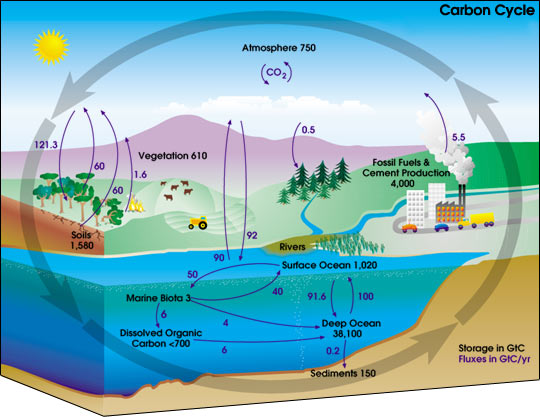
Why does burning gasoline make a difference to the planet? When talking about climate change, it helps to remember that the Earth is a closed system. We only have so much carbon on our planet. Some of it is in solid form -- carbon-based life forms like you and me and the trees outside -- and some of it is in the atmosphere in gases like carbon dioxide (CO2) or methane (CH4).
When we burn fossil fuels, carbon that was in a solid form is released and enters the atmosphere. Atmospheric carbon can then be "breathed in" by trees, grasses, and other plants to enter a solid form again. This is a rather simplified version of the carbon cycle. (In the real-life model, there's
a bunch of carbon "missing" -- unaccounted for in the cycle -- and no one knows exactly where it is going [although forests seem a likely place]. But that's a topic for another blog post!)
 Image credit: NASA, revised version obtained through Wikipedia Commons
The problem with the carbon cycle is that we are changing the ratio of solid carbon to gaseous carbon. When we use drive a car, cut down trees, or burn coal to heat our house, we are moving carbon to the atmosphere. Carbon isn't leaving the atmosphere as fast as it's entering it. And that's a problem.
Carbon dioxide, along with other gases in the atmosphere, acts like a shield. The sun's rays deliver heat to the Earth's surface, but the heat gets trapped in the atmosphere. Just like in a greenhouse, this reflected heat bounces back down to the earth's surface. This warms the Earth, which is a good thing because it keeps us from freezing. But adding too much carbon dioxide to the mix makes the Earth's atmosphere trap too much heat, which causes temperatures to rise. This is known as the
greenhouse effect.
 Image credit: NASA (taken from a 2002 online press release)
Scientists that study the atmosphere can show that the levels of carbon dioxide in the atmosphere are steadily and rapidly increasing. No one knows for sure how the Earth will adapt to these changes.
 Image credit: Dr. Pieter Tans, NOAA/ESRL (www.esrl.noaa.gov/gmd/ccgg/trends)
Think of the earth as a big mixing bowl. The sun's rays are beating down on the Equator, heating up the middle of the planet, while the poles are cold and snow-capped. These differences in temperature drive our weather.
Now, let's say that global warming has increased temperatures around the world. This may not seem like much of a problem at first, especially if you hate winter. But here are three specific concerns:
1) The Earth's weather is going to change. The polar ice caps are melting. The mechanism that drives our weather -- these differences in temperature across the globe -- has been altered. The ratio of the earth's liquid water to ice has changed. These changes are affecting the world's weather. And we have little control over the changes.


South Cascade Glacier, Washington State, United States.
Photo on top taken in 1928, photo on bottom from 2006. Note that the lower part of the glacier has melted by 2006.
Photo credits: 1928 - USDA/USGS; 2006 - USGS, cropped by Mama Joules)Weather is not easy to predict as it is. Adding more confusion isn't going to help us develop good climate models. Although we have ideas, we don't know exactly how the weather is going to change from increased temperatures. As anyone who's watched a weather forecast knows, climate models can only predict so much.
Sometimes, a model completely fails to guess what's going to happen. Climate models are at risk of failure because so many factors (even the amount of volcanic ash in the sky) drive climate change. We know that weather can cause big problems -- things like typhoons, tornadoes, flooding, and drought. If we can't plan for the future, we will be unprepared for disaster when it strikes.
2) Some plants and animals may face extinction. The rate of temperature change might be too rapid for some species on Earth to adapt. Animals that currently live in the coldest climates on Earth -- like polar bears and penguins -- have no where else to go.
 Photo credit: Dave Olsen, U.S. Fish and Wildlife Service
3) The composition of ocean water is changing. Melting polar ice caps create another problem -- they decrease the salinity of the Earth's oceans. The increase in planetary carbon dioxide is also changing the ocean's acidity. The plants and animals that live in the ocean are at risk from these changes. These changes may also affect the way that the ocean functions, like how it deals with pollution or how nutrients cycle through the marine ecosystem.
What can we do? These problems facing our planet can seem overwhelming. But here are some concrete things that you can do to make a difference:
Learn about the greenhouse effect and climate change. Over
7,000 blogs have chosen today,
Blog Action Day 2009 to focus on climate change. Check them out!
Reduce your carbon footprint. Your carbon footprint is the amount of greenhouse gases (like CO2) that is being released into the atmosphere because of your behavior. If you carpool, turn off the lights, recycle, and shop locally, you will be reducing the amount of carbon entering the atmosphere.
Let your voice be heard! Join organizations that are working to understand climate change. As soon as you are old enough, vote! Support candidates that understand the environmental problems facing our planet.
Study science, math, and engineering. Scientists are already finding ways to
sequester carbon (moving carbon from the atmosphere back into a solid form). Someone like you can invent a new and wonderful way to help address our planet's carbon problem!
(My thanks to Kerm and Itinerant Cryptographer for providing helpful comments on early drafts of this post.)