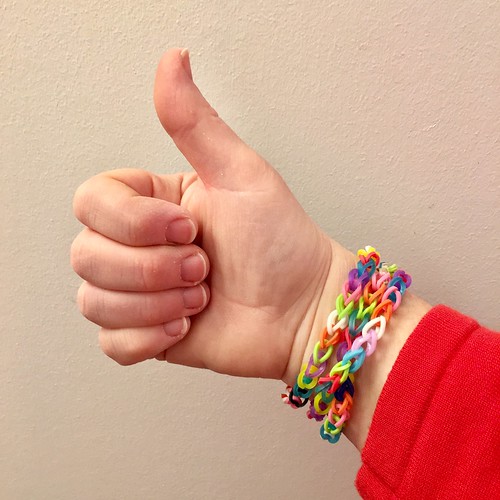
My 9-year-old daughter’s latest obsession is making jewelry from tiny, colorful rubber bands. I’m a firm believer in integrating science education into whatever subject interests a person. So, how could you approach this with crafting?
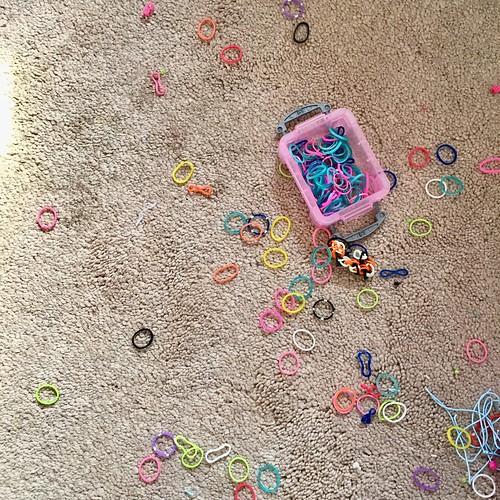
In my daughter’s case, she is a messy crafter. Her floor is currently littered with tiny rubber bands. This presents the perfect opportunity to teach about the theory of evolution, namely camouflage (Which rubber bands blend into the carpet?) and the mechanism of natural selection (Which color bands are the easiest to detect? If you were a predator, these prey would be caught first and wouldn’t have a chance to reproduce.).
Another on-ramp to science would be to discuss the rubber itself. What is rubber anyway? Is it an element? What’s the difference between natural and synthetic rubber? How was rubber first discovered? What else is made of rubber?
You don’t have to know the answers. You and your child can have fun looking them up together. This is the start of scientific inquiry. Scientific research sounds impressive, but all it really means is this: “Research conducted for the purpose of contributing towards science by the systematic collection, interpretation and evaluation of data...” - Turkish Journal of Anaesthesiology and Reanimation.
Scientists are simply curious people who keep asking questions long after others grow bored with the topic. If you can find the right hook to grab a person’s attention, you can make science relevant to (almost) anyone.
Maybe, instead of jewelry, the young crafter in your life likes to use a hot glue gun. This is a great time to talk about the states of matter. Why is the glue now more liquid than solid? What changed? You can introduce the idea that there are more than three states of matter, and that new states of matter are still being discovered!
Collecting natural materials, like pine cones, for crafting can be a nice chance to talk about the types of plants and animals that live in your community. How have they adapted to the climate in your area? For example, some pine trees have serotinous cones that are sealed with resin and require the heat of a fire to release their seeds! (Be sure to bake any pine cones you collect in a low heat oven [200 degrees F] for about 20 minutes before using them. This both kills any insects present and helps to open up the scales.)
Constructing new items out of (relatively clean) waste materials is a great opportunity to introduce the concepts of reduce, reuse & recycle. What happens to our garbage? Can we make crafts from household waste? I went to one training where we were instructed to build a bird out of paper scraps, pipe cleaners, cardboard, and small cans. The only new materials introduced were feathers, glue, and googly eyes. All of our craft birds were so different! This led to an interesting discussion about avian anatomy.
Have you ever used crafts to teach about science? Please share your thoughts in the comments!
