Showing posts with label vegetables. Show all posts

Saturday, January 29, 2011

National Seed Swap Day


Thanks to my friends at Celebrate Green!®, I learned that the last Saturday in January is known as National Seed Swap Day. The event started in 2006 in the Washington, D.C. area, but has quickly spread across the country to become a national event.

  • What is a seed swap?

Simply put, you trade seeds with someone else. Why? You can share extra seeds that you don't need and they won't go to waste. It's a fun way to gain seeds for your garden inexpensively. You might even obtain rare varieties that you can't find in local stores.

  • How do you save seeds?

Jack Rowe has posted a marvelous free Vegetable Seed Saving Handbook to get you started. Some seeds are harder to save than others. Modern-day carrots, for example, can be cross-pollinated by the wild carrot, or Queen Anne's Lace. The seeds you'd wind up with from this cross would not produce tasty carrots.

  • How long do seeds last?

It depends upon the seed. Even the experts disagree, as explored in this post by A Way to Garden.com.

When I was studying wetlands in graduate school, we talked about the government's idea of letting folks drain a wetland as long as they created one somewhere else. This was part of the No Net Loss wetlands policy first touted in the late 1980's.

This line of thinking fails to consider the functionality of wetlands. Wetland soil contains important seeds - a "bank" of future plants. Just adding water to an upland area doesn't turn it into a wetland. Conversely, some industrial areas built on drained wetlands have been successfully converted back to wetlands.

Seeds, when properly cared for, can last a long time.

  • How important is it to save seeds?

One of the problems with modern agriculture is that we tend to fixate on certain types of plants at the expense of others. Let's say we have grown the perfect tomato. Other tomato varieties might be discounted because their fruits are too small, too squishy, maybe a funny color. If no one saves these seeds, we are in for a big problem when later, our perfect tomato falls prey to an insect or disease. Some of these lesser varieties might be resistant, but if we don't save the seeds, we don't have a way to deal with the problem.

This is the rationale behind seedbanks - we want to save the seeds for posterity. You never know when we might need them.

  • How can I swap seeds?

Ask your friends and neighbors to swap seeds with you. The advantage of swapping seeds locally is that you know they are likely to grow in your climate and they won't harm your local ecosystem.

The National Gardening Association has set up this page to help you swap seeds online. HeirloomSeedSwap.com is an international seed swapping site. But be careful when sending seeds long distances - a seed that is welcome in your area might be considered an invasive somewhere else.

Happy swapping!


Photo credit: Kirsty Hall, via flickr // CC BY 2.0

Thursday, July 2, 2009

Take the lead out of gardening


Did you hear that lead was detected in soil from the White House vegetable garden? I wasn't surprised. Although lead is not widely in use today, prior to 1978, it was a common additive in paint and gasoline. Lead was widely deposited in urban soils through car exhaust and flaking paint from building exteriors. In rural and formerly rural areas, lead may be present in soil from the historic use of lead-containing pesticides like lead arsenate. (If your neighborhood has streets with names like "orchard" or "farm", you probably live on former farmland.)

Since lead is a metal, it is persistent in soil. Unlike a volatile compound (think gasoline fumes), lead tends to stay put. Some of this lead may be bioavailable, meaning it can enter your plants and, ultimately, you and your family.

But don’t let your concerns about lead exposure dampen your enthusiasm for gardening with your kids! There are easy steps that you can take to limit this problem:

• Locate your garden away from roads and buildings. This 1995 study showed that soils in some inner-city front yards in Washington, DC were contaminated with lead; the source was traced to paint.

• Consider importing fresh topsoil for your garden. You can work this soil into your planting beds or use containers and elevated planters.

• Make sure that you and your children wash your hands after gardening and remove your shoes before coming into the house. Wipe the feet of pets that have been in the garden with you.

• Wash all fruits and vegetables thoroughly before eating them. Ingesting contaminated soil poses a greater human health risk than eating foods grown in contaminated soil.

• Studies have shown that leafy greens (like lettuce) and roots (such as carrots and onions) are the most likely to uptake metals. If you are concerned about the soil in your garden, you may want to grow fruits, like tomatoes, which are less likely to become contaminated.

At 93 parts per million, the lead levels found in the White House garden are actually quite low for urban soils; values over 400 ppm lead might raise an eyebrow. To learn more about the possible risks of lead exposure from gardening, check out:

"Leaden Gardens" from ScienceNews

"Lead in the Home Garden and Urban Soil Environment" from the University of Minnesota Extension Office

And to learn more about lead and lead poisoning, visit:

"Blood-Lead Level Basics: What You Really Need to Know" from Washington Parent

Public Health Statement for Lead from the Agency for Toxic Substances and Disease Registry.


A portion of this article appeared previously in Natural Family Online.

Photo credit: Leon Brooks, BurningWell.org

Friday, August 1, 2008

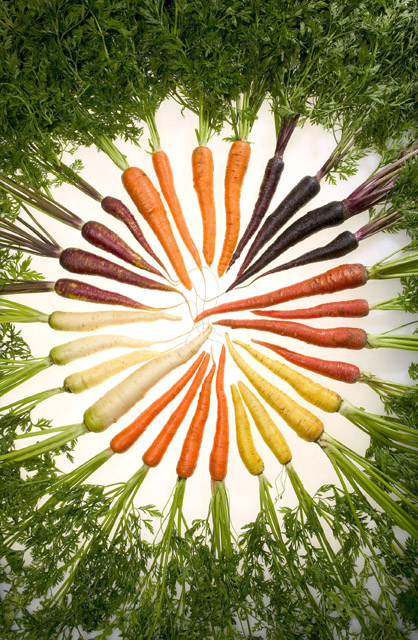
Website of the Week: World Carrot Museum

Photo credit: Stephen Ausmus, Agricultural Research Service, USDA

It's been a long week here at Mama Joules, so I scoured the web for something truly unique for this week's website. Ta-da! "Discover the power of Carrots" at the World Carrot Museum!

Learn all about the different types and colors of carrots (including white, purple, and black ... who knew?) at The Carrot Today. Try some simple science experiments with carrots. Explore the history of the carrot or plan your next trip to coincide with a carrot festival. And be sure to drop by Mr. Carrot Head to give him a new face!

P.S. In honor of carrots, I also found this great photo of some kids in Japan doing a carrot dance.

Wednesday, March 26, 2008

The Field Guide to Produce

Charentais melons
Photo credit: Neal Ziring

Do you ever wish that you had the time to take a field trip with your family? Never fear! Now, with Aliza Green's Field Guide to Produce, you can have fun scouring the local farmer's market or green grocer for your next meal. Learn to identify exotic fruits and vegetables -- such as quince, kumquats, amaranth greens, and yuzus -- with handy tips for how to prepare and eat them, too.