Showing posts with label kids. Show all posts

Sunday, March 18, 2018

Using Crafts to Teach Science (Science Literacy Series #2)

Rubber Band Bracelets
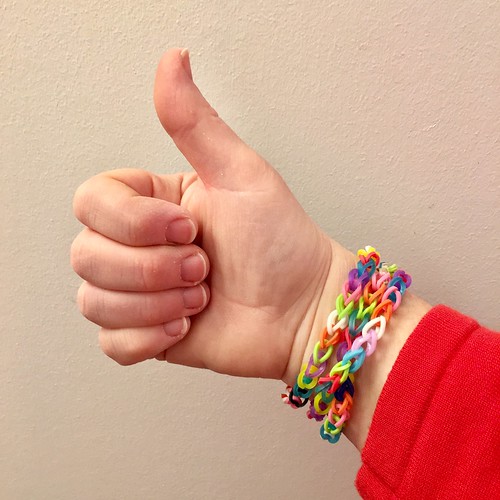
My 9-year-old daughter’s latest obsession is making jewelry from tiny, colorful rubber bands. I’m a firm believer in integrating science education into whatever subject interests a person. So, how could you approach this with crafting?

In my daughter’s case, she is a messy crafter. Her floor is currently littered with tiny rubber bands. This presents the perfect opportunity to teach about the theory of evolution, namely camouflage (Which rubber bands blend into the carpet?) and the mechanism of natural selection (Which color bands are the easiest to detect? If you were a predator, these prey would be caught first and wouldn’t have a chance to reproduce.).
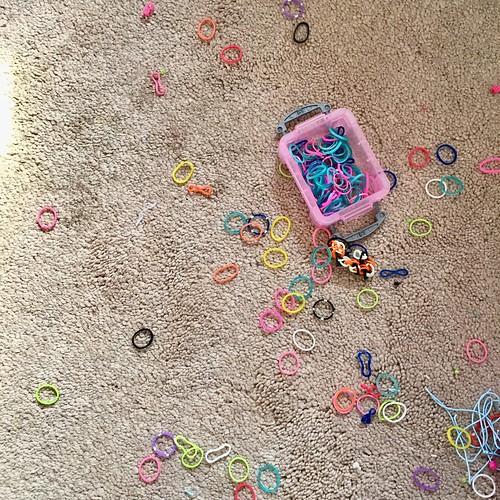
Rubber Band Bracelet Supplies
Another on-ramp to science would be to discuss the rubber itself. What is rubber anyway? Is it an element? What’s the difference between natural and synthetic rubber? How was rubber first discovered? What else is made of rubber?

You don’t have to know the answers. You and your child can have fun looking them up together. This is the start of scientific inquiry. Scientific research sounds impressive, but all it really means is this: “Research conducted for the purpose of contributing towards science by the systematic collection, interpretation and evaluation of data...” - Turkish Journal of Anaesthesiology and Reanimation.

Scientists are simply curious people who keep asking questions long after others grow bored with the topic. If you can find the right hook to grab a person’s attention, you can make science relevant to (almost) anyone.

Maybe, instead of jewelry, the young crafter in your life likes to use a hot glue gun. This is a great time to talk about the states of matter. Why is the glue now more liquid than solid? What changed? You can introduce the idea that there are more than three states of matter, and that new states of matter are still being discovered!

Collecting natural materials, like pine cones, for crafting can be a nice chance to talk about the types of plants and animals that live in your community. How have they adapted to the climate in your area? For example, some pine trees have serotinous cones that are sealed with resin and require the heat of a fire to release their seeds! (Be sure to bake any pine cones you collect in a low heat oven [200 degrees F] for about 20 minutes before using them. This both kills any insects present and helps to open up the scales.)

Constructing new items out of (relatively clean) waste materials is a great opportunity to introduce the concepts of reduce, reuse & recycle. What happens to our garbage? Can we make crafts from household waste? I went to one training where we were instructed to build a bird out of paper scraps, pipe cleaners, cardboard, and small cans. The only new materials introduced were feathers, glue, and googly eyes. All of our craft birds were so different! This led to an interesting discussion about avian anatomy.

Have you ever used crafts to teach about science? Please share your thoughts in the comments!


Friday, June 17, 2011

Freebies for Science Teachers


The National Science Teachers Association (NSTA) has put together Freebies for Science Teachers, a list of links to online reference material and other goodies like these:
According to the NSTA website, the National Science Teachers Association "is the largest organization in the world committed to promoting excellence and innovation in science teaching and learning for all."

If you are a second or third year secondary science teacher in the United States, now is the time to apply for NSTA's New Science Teacher Academy, a program providing free professional development and mentoring. Two hundred teachers will be accepted as new Fellows for the 2011 Academy. The application deadline is August 1, 2011. Good luck!


Photo credit: Wm Chamberlain, via flickr // CC BY 2.0

Monday, May 3, 2010

Gardening Goodness


I thought I'd share what Kerm and I were up to this week-end. We finally planted all of the geraniums, replanted the petunias and marigolds in potting soil instead of garden soil (didn't realize just how dry "garden soil" could get!), and transplanted almost all of the strawberry plants into our new, nifty, clay strawberry planter. It was a productive Saturday.


Photo credits: Mama Joules

Monday, April 5, 2010

In praise of gardening ...


My boys and I spent the day in the dirt. I had to reseed the grass, so we dug up the top layer of soil, added a soil amendment, and put down a grass patching material. Our native soils are rocky with a high clay content, but since I added a layer of topsoil last year, it was interesting to observe what came up in my spade. The boys were fascinated by the worms, grubs, rocks, and roots. I pondered why some shovelfuls were brown topsoil mixed with orange clay and some were all orange clay: a clear sign that some of last year's topsoil was missing. Where did the topsoil go? Our lawn is flat, so how did it wash away?

We all liked planting flowers in the front yard. Baby Princess watched us from her exersaucer. Each boy has his own pot and every year I let the boys pick out the types of flowers that they want to plant. We went to Home Depot and picked up whatever caught our eye. Little Brother chose a yellow-orange marigold and some light purple flowers this year. I'm partial to petunias and snapdragons so I have a couple of those in my pot. Kerm decided on a tomato plant in addition to his flowers. I really wanted to get him a strawberry planter, but I couldn't find one.

I keep intending to "go native" and grow native plants, but I haven't gotten around to it yet. I wish that native plants were easier to find in the marketplace. Where I live, most gardening centers don't carry them. And I would need some help to get started, especially since I didn't grow up here and I'm not familiar with plants native to the Mid-Atlantic region.

I have to admit, for someone who likes gardening as much as I do, I don't know very much about flowers. But I know enough to show my boys how to "crack" the plastic bedding pots and gently tug on the flowers until the root balls of the plants are released. I showed the boys that you don't carry a plant by its flowers but instead hold the stem, just above the roots. I reminded them to break up the root ball before burying it into the newly dug soil. And after placed the flower pots onto the steps of our home, I watered both the plants and the kids.

The house looks ready for summer now. It was a good day.


Photo credit: D. Sharon Pruitt, via flickr // CC BY 2.0