Showing posts with label snow. Show all posts

Wednesday, March 21, 2018

Spring Snow!

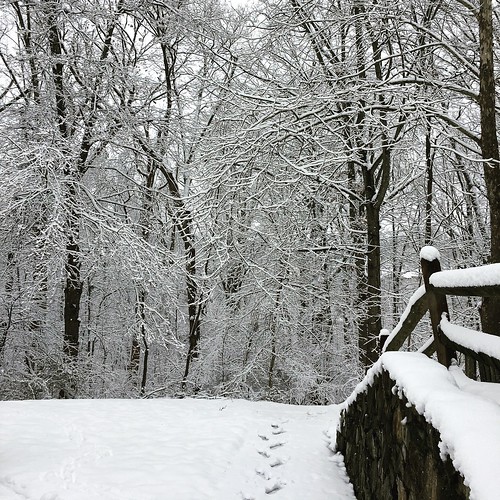
Today, I had the pleasure of enjoying the freak March snowstorm with my middle child, Little Brother. We were both so excited to see a decent snowfall - last winter, we barely saw any snow where we live in the suburbs of Washington, D.C.

This snow was thick and heavy, coming down on a layer of ice, and the trees were simply stunning. There’s something truly magical about driving around and hopping out of the car at random intervals to take photos, or in having your almost-teen son share his favorite park.

I wish you all a day of glitter and sparkles.

Spring Snow 2018

Friday, February 6, 2015

A Naturalist's Thoughts on Winter Weather

February in the Mid-Atlantic can bring a wide range of weather - anything from sunny and balmy to freezing cold and snowy. This variability contributes to a wide range of winter precipitation. A wintry mix is a combination of rain, snow, freezing rain, and sleet.

Rain is liquid precipitation. The diameter of the droplets determines whether you have fog, mist, drizzle, light rain, moderate rain, heavy rain, excessive rain, or a cloudburst. Cloudburst droplets, although small at 2.85 mm in diameter, are over 200 times larger than fog droplets. (I wrote a previous post on this topic called How Big Are Raindrops?).

Snow consists of ice particles frozen into complex, six-sided patterns. Non-branching ice crystals - or diamond dust - form in the shapes of needles, columns, or plates.

Little Brother was very little when I took this photo of him playing in the snow.
He was very proud of his snowman!

Freezing Rain occurs when the atmosphere is warm enough for rain, but ground temperatures are 32 degrees F or lower. The rain freezes instantly when it hits the ground, coating everything in a layer of ice. Freezing drizzle is similar, but the individual drops of water are smaller. Freezing fog occurs when ice crystals are suspended in fog.

 I took this picture after an ice storm last winter. The rain froze the instant it hit the tree branches.

Sleet forms when snow melts in the atmosphere and then refreezes before it hits the ground. Sleet does not stick to objects the way freezing rain does.

This article (sans photographs) was first posted at the Audubon Naturalist Society. Come visit Woodend!

Saturday, February 6, 2010

The Blizzard of 2010

This is what I woke up to this morning.


Believe it or not, there are cars under there!


I have to admit, when the weathercasters referred to our December 2009 snowfall as a blizzard, I was skeptical. But this snowstorm clearly meets the definition. Intense snowfall, heavy wind, broken tree branches, and, of course, lots and lots of snow. And, 24 hours later, it's still snowing!

Look at the amount of snow on that mailbox!
Note the broken tree branch in the background.

The Science of Snow

Two years ago, I had the pleasure of interviewing Dr. Joseph M. Moran, of the American Meteorological Society, for an article about snow that appeared in Washington Parent magazine. Given that snowy weather has taken over much of the United States, I thought you might enjoy this reprint of our conversation.

***

The Science of Snow: Ask the Expert!

Dr. Joseph M. Moran, of the American Meteorological Society, answers your questions about snow:

1. Is it true that no two snowflakes are alike?

Dr. Moran says, "‘No two snowflakes are alike' is a widely held assumption. Although all snowflakes are composed of ice crystals having six-sided ... symmetry, they may occur in billions of different forms." Even so, a researcher discovered two identical snowflakes while sampling clouds over Wisconsin in 1988.

2. Are there different kinds of snow?

"Yes," says Dr. Moran. He explains, "Snow is an agglomeration of ice crystals in the form of flakes that develop in clouds and fall to the Earth's surface. Snowflakes vary in shape and size depending on air temperature and humidity. With decreasing cloud temperature, snowflake crystals occur as needles, dendrites, plates, and columns."


A dendrite snowflake below; a plate snowflake on the right. Both of these images were taken by Wilson "Snowflake" Bentley. For more information, SnowCrystals.com has nice descriptions of different types of snowflakes.


"Snowflake size depends in part on how humid (moist) the air is. At very low temperatures, the humidity is relatively low, and snowflakes tend to be small. Snowflake size also depends on the efficiency with which they collide with one another as they fall through the atmosphere to the ground. At air temperatures near freezing, snowflakes more readily stick together after colliding, and their diameters sometimes reach 2 to 4 inches (5 to 10 centimeters). Snow pellets and snow grains are similar to snowflakes but much smaller. Snow pellets are soft conical or spherical white particles of ice with diameters of 2 to 5 millimeters. Snow grains are flat or elongated opaque white particles of ice, usually less than 1 millimeter in diameter."

3. How do meteorologists measure snow? My measurements at home never seem to match what the weathercaster says.

Meteorologists measure three things, says Dr. Moran: "The depth of snow that falls between successive observations, the meltwater equivalent of that snowfall, and the depth of snow on the ground at observation time."

Dr. Moran tells us how to measure a storm's snowfall like the experts. "Prior to an anticipated snowfall, place a simple wooden board on the ground ... New snowfall accumulates on the board, and at observation time a ruler is used to measure the snow depth to the board. Record the snowfall ... and sweep the snowboard clean so that it is ready to receive new snowfall. Repeat this process throughout the snow event, and then compare your total snowfall with that reported by the local television or broadcast meteorologist. Note that snowfall is notoriously variable from one place to another ..." depending upon things like temperature, the distance you are from the ocean, and the track of the storm.


Photo credits: Wilson Bentley, from NOAA's National Weather Service Collection.

Friday, February 5, 2010

Ten Tips for Celebrating Snow Days

With the forecast for much of the United States calling for snow sometime in the next week, I thought I'd re-post these ten tips for making the most of snow days. (This post is excerpted from my original article, which was published in Washington Parent magazine in January 2007.)


The forecast is grim: snow, snow, and more snow. What are you going to do all day? Before you go stir-crazy, try these ten tips for turning a snow day into together time:

1. Have an all-white day. Encourage everyone in the house to wear white. Prepare your family all-white meals like oatmeal with milk for breakfast and chicken breast, mashed potatoes and cauliflower for dinner.

2. Make snow-themed treats together. Bake your favorite cookies and add a dusting of powdered sugar "snow" on top. Make marshmallow snowmen using candies for eyes, raisins for buttons and pretzel sticks for arms.

3. Read about Wilson "Snowflake" Bentley. Virginia mom Karen Cole, founder of Big Learning, suggests the book Snowflake Bentley by Jacqueline Briggs Martin and the Snowflake Bentley website. In 1885, Bentley became the first person to photograph individual snowflakes; in his lifetime, he took pictures of more than 5,000 different snowflakes (including the picture at the top of this post!).

4. Have a snow-inspired movie marathon. Bring out snowy family favorites like Ice Age and March of the Penguins. To increase the educational value, break out the encyclopedias or hop on the Internet to learn about glaciation or the continent of Antarctica. Be glad that you don't live at Vostok Station in Antarctica, where the coldest recorded temperature on Earth was observed on July 21, 1983 (-128.6°F / -89.2°C).

5. Conduct scientific experiments with snow.

"Even though freshly fallen snow appears bright white and clean, it is not," says Dr. Joseph M. Moran of the American Meteorological Society. Dr. Moran is the author of a brand new textbook, Climate Studies: Introduction to Climate Science.

"One of my favorite activities goes a long way to convincing children not to eat snow. You will need a 1- or 2-gallon pail, large paper coffee filter, paper towels, and a magnifying glass … Scoop up a large pail of freshly fallen snow and bring it indoors to a warm room. Set the pail down undisturbed until all the snow melts. Then, over a sink, slowly and carefully pour the meltwater through a paper coffee filter. Set the coffee filter aside on some paper towels until it dries. Next, examine the surface of the dry coffee filter … What do you see? Where did that material come from?"

He adds, "As snowflakes fall through the atmosphere, they intercept and capture a variety of tiny particles that are suspended in the atmosphere and carried by the wind. Most of these particles originated at the Earth's surface. [You can] speculate on what these particles might be."


6. Have your kids play "cool" word games. For example, ask them the following questions: How many words can you think of that start with the word "snow"? (snowflake, snowplow, snowstorm, snowmobile …). How many words can you make from the letters in the word "snowflake"? (sow, now, lake, wake …). For a harder challenge, try making words from the letters in the word "avalanche" (ache, vale, lava, leach, lane …).

7. Try recipes made with snow. (Although, after reading Dr. Moran's comments, you might wish to make your own "snow" by mixing ice from the freezer in your blender!). Scoop up some fresh snow, and mix it with fruit juice to make a snow cone. Or make Snow Cream: Scoop snow into a large bowl, and blend in 1 cup milk or cream, 1/2 cup sugar and a few drops of vanilla. Enjoy!

8. Compete in your version of the Winter Olympic Games. See who can throw a snowball the farthest or sled down a hill the fastest. Stuck indoors? Glide over the kitchen tiles in your socks and have an ice-skating competition.

9. Go outside and examine individual snowflakes.

Dr. Moran says, "This activity requires a sheet of black construction paper or a dark cloth, a magnifying glass, a journal and a pencil. During a snowfall, go outdoors and hold the construction paper or cloth horizontally to catch some snowflakes. Take care that the heat from your breath or fingers does not melt the snowflakes. Using the magnifying glass, examine the individual snowflakes. Describe what [shapes] you see, and draw some of them in your journal. Are any of the snowflakes identical in appearance?"

He notes, "Recording data in a journal is a good introduction to scientific observation and the scientific method."


10. Share your family's favorite snowy memories. Do you remember when you saw snow for the first time? Ever caught a snowflake on your tongue? What was the deepest snowfall that you can remember? You might be surprised at what your family members share with you. Sometimes, a day spent together "doing nothing" turns into a cherished memory.


Photo credit: Wilson Bentley. This picture is part of NOAA's National Weather Service Collection and was taken in 1902.
Saturday, December 19, 2009

Snow!

The view from my back door


Where I live along the Eastern seaboard in the US, we are in the middle of a record-breaking snowfall. For you folks out west or in other snowy climes, this storm wouldn't seem like much. But here, this quantity of snow is shocking!


Kerm and Little Brother went sledding today -- the first time ever for Little Brother. They had a wonderful time. :)

Tuesday, December 8, 2009

Make-A-Flake

Last year, I wrote a post about the joy of paper snowflakes, and how it was fun to make them both on- and off-line. One of the websites my kids and I enjoyed was Barkley Interactive's Make-A-Flake.

Little Brother made his own snowflakes this year!

Make-A-Flake is fun because you get to see how to properly fold (virtual) paper to make a six-sided snowflake. You can cut (and re-cut) with your virtual scissors to get the desired effect. A trip through Make-A-Flake's snowflake gallery reveals a wide range of artistry. Some snowflakes are very simple, others are truly amazing. Can you tell which cuts were needed to make them?

I can't visualize my snowflakes before they are unfolded to reveal their shape. Can you predict what yours will look like? I think it's an interesting test of spatial awareness. As person with only one working eye, I have some limitations in that area.

I enjoyed making some snowflakes, too. I think this one looks like six aliens around a campfire. What do you think?

Monday, December 22, 2008

The joy of paper snowflakes

My boys and I are wishing it would snow in our little corner of the world, but no such luck. While the rest of the U.S. has been blanketed in white, we are soggy instead of icy. So, we decided to make some paper snowflakes this week-end.

It's been a long time since I've made a paper snowflake. My first attempts were round instead of six-sided. But I soon got the hang of it, thanks in part to Make-a-Flake. Make-a-Flake shows you how to fold your paper into the right shape to make a six-sided snowflake, and then allows you to make practice cuts online. You can undo and redo your cuts until you get the shape you like, and you can post your finished flake in the online gallery. My younger son and I worked together to make the one shown above.

Zefrank.com has a different take on creating online snowflakes. When you visit Zefrank's Create Your Own Snowflakes, you can layer simple shapes and rotate them in 2 or 3 dimensions to create a snowflake effect.

We've come a long way since scissors and paper, but there's still nothing like cutting out your own paper snowflakes and hanging them in the window. If you're looking for inspiration, check out the wonderful collection of Wilson Bentley's snowflake photography in NOAA's Photo Library (search for "snowflake"). These photographs were taken by Wilson in 1902 in Jericho, Vermont.


Photo credit: National Weather Service


P.S. [UPDATE:1/9/09] Thanks to a tip from Andy's Parties, I found another on-line snowflake making site,
Rooney Design's Snowflake Factory
. Very fun!

Friday, November 23, 2007

Website of the Week: Snow Crystals

In my part of the world, the weather is finally starting to look like winter. My boys and I have been anxiously watching The Weather Channel, hoping for a snowy forecast.

So, this week’s tip of the hat goes to Snow Crystals, a website devoted to the beauty and science of snowflakes. Learn the physics behind snowflake formation, see how to preserve a snowflake, and check out the beautiful pictures in the photo gallery.

A nod also goes to the American Library Association, for pointing me to this great website through their aptly named listing of Great Websites for Kids.